Advertisements
Advertisements
प्रश्न
A thin paper of thickness 0.02 mm having a refractive index 1.45 is pasted across one of the slits in a Young's double slit experiment. The paper transmits 4/9 of the light energy falling on it. (a) Find the ratio of the maximum intensity to the minimum intensity in the fringe pattern. (b) How many fringes will cross through the centre if an identical paper piece is pasted on the other slit also? The wavelength of the light used is 600 nm.
Advertisements
उत्तर
Given:-
The thickness of the thin paper,
\[t = 0 . 02 mm = 0 . 02 \times {10}^{- 3} m\]
Refractive index of the paper,
\[\mu = 1 . 45\]
Wavelength of the light,
\[\lambda = 600 nm = 600 \times {10}^{- 9} m\]
(a)
Let the intensity of the source without paper = I1
and intensity of source with paper =I2
Let a1 and a2 be corresponding amplitudes.
As per the question,
\[I_2 = \frac{4}{9} I_1\]
We know that
\[\frac{I_1}{I_2} = \frac{{a_1}^2}{{a_2}^2}............\left( \because I \propto a^2 \right)\]
\[ \Rightarrow \frac{a_1}{a_2} = \frac{3}{2}\]
Here, a is the amplitude.
We know that \[\frac{I_\max}{I_\min} = \frac{\left( a_1 + a_2 \right)^2}{\left( a_1 - a_2 \right)^2}. \]
\[ \Rightarrow \frac{I_\max}{I_\min} = \frac{\left( 3 + 2 \right)^2}{\left( 3 - 2 \right)^2}\]
\[= \frac{25}{1}\]
\[ \Rightarrow I_\max : I_\min = 25 : 1\]
(b)
Number of fringes that will cross through the centre is given by \[n = \frac{\left( \mu - 1 \right)t}{\lambda}\]
\[\Rightarrow n = \frac{\left( 1 . 45 - 1 \right) \times 0 . 02 \times {10}^{- 3}}{600 \times {10}^{- 9}}\]
\[= \frac{0 . 45 \times 0 . 02 \times {10}^4}{6} = 15\]
APPEARS IN
संबंधित प्रश्न
Show that the fringe pattern on the screen is actually a superposition of slit diffraction from each slit.
Using monochromatic light of wavelength λ in Young’s double slit experiment, the eleventh dark fringe is obtained on the screen for a phase difference of ______.
Explain two features to distinguish between the interference pattern in Young's double slit experiment with the diffraction pattern obtained due to a single slit.
In a Young's double slit experiment, two narrow vertical slits placed 0.800 mm apart are illuminated by the same source of yellow light of wavelength 589 nm. How far are the adjacent bright bands in the interference pattern observed on a screen 2.00 m away?
A plate of thickness t made of a material of refractive index µ is placed in front of one of the slits in a double slit experiment. (a) Find the change in the optical path due to introduction of the plate. (b) What should be the minimum thickness t which will make the intensity at the centre of the fringe pattern zero? Wavelength of the light used is \[\lambda.\] Neglect any absorption of light in the plate.
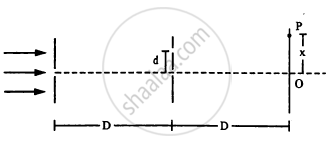
Consider the arrangement shown in the figure. The distance D is large compared to the separation d between the slits.
- Find the minimum value of d so that there is a dark fringe at O.
- Suppose d has this value. Find the distance x at which the next bright fringe is formed.
- Find the fringe-width.
How is the fringe width of an interference pattern in Young's double-slit experiment affected if the two slits are brought closer to each other?
When a beam of light is used to determine the position of an object, the maximum accuracy is achieved, if the light is ______.
"If the slits in Young's double slit experiment are identical, then intensity at any point on the screen may vary between zero and four times to the intensity due to single slit".
Justify the above statement through a relevant mathematical expression.
A thin circular ring of mass M and radius R is rotating about its axis with a constant angular velocity ω. Two objects each of mass m are attached gently to the opposite ends of diameter of the ring. The ring will now rotate with an angular velocity:
The Young's double slit experiment is performed with blue and with green light of wavelengths 4360Å and 5460Å respectively. If x is the distance of 4th maxima from the central one, then:
ASSERTION (A): In an interference pattern observed in Young's double slit experiment, if the separation (d) between coherent sources as well as the distance (D) of the screen from the coherent sources both are reduced to 1/3rd, then new fringe width remains the same.
REASON (R): Fringe width is proportional to (d/D).
In Young's double slit experiment using light of wavelength 600 nm, the slit separation is 0.8 mm and the screen is kept 1.6 m from the plane of the slits. Calculate
- the fringe width
- the distance of (a) third minimum and (b) fifth maximum, from the central maximum.
A beam of light consisting of two wavelengths 600 nm and 500 nm is used in Young's double slit experiment. The silt separation is 1.0 mm and the screen is kept 0.60 m away from the plane of the slits. Calculate:
- the distance of the second bright fringe from the central maximum for wavelength 500 nm, and
- the least distance from the central maximum where the bright fringes due to both wavelengths coincide.
In Young's double-slit experiment, the screen is moved away from the plane of the slits. What will be its effect on the following?
- The angular separation of the fringes.
- Fringe-width.
What did Young's double-slit experiment provide strong evidence for?
What is the interference pattern observed on the screen in Young's double-slit experiment?
What is the fringe width \(\beta\) in Young's double-slit experiment?
