Advertisements
Advertisements
प्रश्न
In Young's double slit experiment, show that:
`β = (λ"D")/"d"`
Where the terms have their usual meaning.
Advertisements
उत्तर
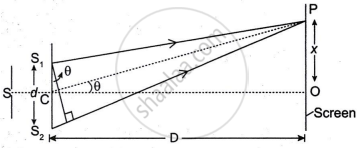
Assume that S is a light source that is receiving light from another light source. Two line sources, S1 and S2, are equally spaced apart from light source S.
Let S1S2 = d
Path difference between waves at point P,
S2P - S1P = S2A
ΔS1S2A and ΔPCO are similar to each other.
∴ `("S"_2"A")/("S"_1"S"_2) =("OP")/("CP")`
Since CO is very much greater than S1S2,
So CP ≈ CO
∴ `("S"_2"A")/("S"_1"S"_2) = ("OP")/("CO")`
`("S"_2"A")/"d" = x/"D"`
∴ Path difference = `x/"D"`
For bright fringes, = mλ
`x = m ("D"λ)/"d"`
For mth and (m + 1)th fringe,
`x_m = m ("D"λ)/"d"` and
`x_(m + 1) = (m + 1) ("D"λ)/"d"`
Fringe width, `β = x_(m + 1) - x_m`
= `(m + 1) ("D"λ)/"d" - m ("D"λ)/"d"`
`β = ("D"λ)/"d"`
APPEARS IN
संबंधित प्रश्न
In a double-slit experiment using the light of wavelength 600 nm, the angular width of the fringe formed on a distant screen is 0.1°. Find the spacing between the two slits.
In Young’s double slit experiment using monochromatic light of wavelength λ, the intensity of light at a point on the screen where path difference is λ, is K units. Find out the intensity of light at a point where path difference is λ/3.
If the source of light used in a Young's double slit experiment is changed from red to violet, ___________ .
An unpolarised beam of intensity 2a2 passes through a thin polaroid. Assuming zero absorption in the polaroid, the intensity of emergent plane polarised light will be
In a Young's double slit experiment, the width of the one of the slit is three times the other slit. The amplitude of the light coming from a slit is proportional to the slit- width. Find the ratio of the maximum to the minimum intensity in the interference pattern.
The central fringe of the interference pattern produced by the light of wavelength 6000 Å is found to shift to the position of the fourth bright fringe after a glass plate of refractive index 1.5 is introduced in the path of one of the beams. The thickness of the glass plate would be ______.
Two beams of light having intensities I and 41 interfere to produce a fringe pattern on a screen. The phase difference between the two beams are π/2 and π/3 at points A and B respectively. The difference between the resultant intensities at the two points is xl. The value of x will be ______.
What is the consequence of random phase variation for ordinary light sources?
What path difference produces a bright fringe?
What happens to fringe width when the wavelength of light increases while screen distance and slit separation remain unchanged?
