Advertisements
Advertisements
प्रश्न
A transparent paper (refractive index = 1.45) of thickness 0.02 mm is pasted on one of the slits of a Young's double slit experiment which uses monochromatic light of wavelength 620 nm. How many fringes will cross through the centre if the paper is removed?
Advertisements
उत्तर
Given:-
Refractive index of the paper, μ = 1.45
The thickness of the plate,
\[t = 0 . 02 mm = 0 . 02 \times {10}^{- 3} m\]
Wavelength of the light,
\[\lambda = 620 nm = 620 \times {10}^{- 9} m\]
We know that when we paste a transparent paper in front of one of the slits, then the optical path changes by \[\left( \mu - 1 \right)t.\]
And optical path should be changed by λ for the shift of one fringe.
∴ Number of fringes crossing through the centre is
\[n = \frac{\left( \mu - 1 \right)t}{\lambda}\]
\[ = \frac{\left( 1 . 45 - 1 \right) \times 0 . 02 \times {10}^{- 3}}{620 \times {10}^{- 9}}\]
\[ = 14 . 5\]
Hence, 14.5 fringes will cross through the centre if the paper is removed.
APPEARS IN
संबंधित प्रश्न
Explain two features to distinguish between the interference pattern in Young's double slit experiment with the diffraction pattern obtained due to a single slit.
If one of two identical slits producing interference in Young’s experiment is covered with glass, so that the light intensity passing through it is reduced to 50%, find the ratio of the maximum and minimum intensity of the fringe in the interference pattern.
Write three characteristic features to distinguish between the interference fringes in Young's double slit experiment and the diffraction pattern obtained due to a narrow single slit.
In Young’s double slit experiment using monochromatic light of wavelength λ, the intensity of light at a point on the screen where path difference is λ, is K units. Find out the intensity of light at a point where path difference is λ/3.
How does an unpolarized light incident on a polaroid get polarized? Describe briefly, with the help of a necessary diagram, the polarization of light by reflection from a transparent medium.
The slits in a Young's double slit experiment have equal width and the source is placed symmetrically with respect to the slits. The intensity at the central fringe is I0. If one of the slits is closed, the intensity at this point will be ____________ .
If Young's double slit experiment is performed in water, _________________ .
The separation between the consecutive dark fringes in a Young's double slit experiment is 1.0 mm. The screen is placed at a distance of 2.5m from the slits and the separation between the slits is 1.0 mm. Calculate the wavelength of light used for the experiment.
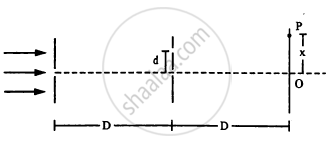
Consider the arrangement shown in the figure. The distance D is large compared to the separation d between the slits.
- Find the minimum value of d so that there is a dark fringe at O.
- Suppose d has this value. Find the distance x at which the next bright fringe is formed.
- Find the fringe-width.
Why is the diffraction of sound waves more evident in daily experience than that of light wave?
ASSERTION (A): In an interference pattern observed in Young's double slit experiment, if the separation (d) between coherent sources as well as the distance (D) of the screen from the coherent sources both are reduced to 1/3rd, then new fringe width remains the same.
REASON (R): Fringe width is proportional to (d/D).
A fringe width of 6 mm was produced for two slits separated by 1 mm apart. The screen is placed 10 m away. The wavelength of light used is 'x' nm. The value of 'x' to the nearest integer is ______.
Interference fringes are observed on a screen by illuminating two thin slits 1 mm apart with a light source (λ = 632.8 nm). The distance between the screen and the slits is 100 cm. If a bright fringe is observed on a screen at distance of 1.27 mm from the central bright fringe, then the path difference between the waves, which are reaching this point from the slits is close to :
In Young's double-slit experiment, the separation between the two slits is d and the distance of the screen from the slits is 1000 d. If the first minima fall at a distance d from the central maximum, obtain the relation between d and λ.
What is fringe width?
Why do the two narrow slits in Young's experiment act as coherent sources?
What does \(x\) denote when deriving fringe positions?
What does \(\lambda\) denote in the fringe-position expressions?
What happens to fringe width when the screen distance increases while wavelength and slit separation remain unchanged?
