Advertisements
Advertisements
प्रश्न
In Young’s double slit experiment to produce interference pattern, obtain the conditions for constructive and destructive interference. Hence deduce the expression for the fringe width.
Advertisements
उत्तर
For any other incoherent source of light a steady interference pattern can never be obtained, even if the sources emit waves of equal wavelengths and equal amplitudes. This is because the waves emitted by a source undergo rapid and irregular changes of phase, so that the intensity at any point is never constant. Naturally the phase difference between the waves emitted by the two sources cannot remain constant.
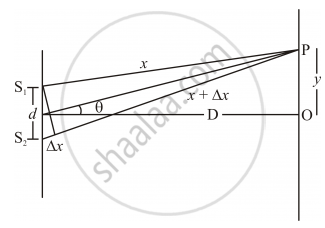
The two waves interfering at P have different distances S1P = x and S2P = x + Δx.
So, for the two sources S1 and S2we can respectively write,
`I_1 = I_(01) sin (kx -wt)`
`I_1 = I_(02) sin (k(x +Deltax)-wt) =I_(02)sin(kx -wt +delta)`
`delta = kDeltax =((2pi)/lambda) xx Delta x`
The resultant can be written as,
`I =I_0sin(kx -wt +epsi)
Where` I_0^2 =I_(01)^2 + I_(02)^2 +2I_(01) I_(02) cos delta`
And tan`epsi = I_(02) sin delta /(I_(01) +I_(02)cos delta)`
The condition for constructive (bright fringe) and destructive (dark fringe) interference are as follows;
δ = 2nπ for bright fringes
δ = (2n + 1) π for dark fringes
Where n is an integer.
Now to find the fringe width,
The path difference is `Deltax =S_2P-S_1P` nearly equal to d `sintheta =d tantheta =(dy)/D`
Hence we can write, `y=(nlambdaD)/d ,n` is an integer.
APPEARS IN
संबंधित प्रश्न
Using analytical method for interference bands, obtain an expression for path difference between two light waves.
A thin transparent sheet is placed in front of a Young's double slit. The fringe-width will _____________ .
The separation between the consecutive dark fringes in a Young's double slit experiment is 1.0 mm. The screen is placed at a distance of 2.5m from the slits and the separation between the slits is 1.0 mm. Calculate the wavelength of light used for the experiment.
In a Young's double slit experiment, \[\lambda = 500\text{ nm, d = 1.0 mm and D = 1.0 m.}\] Find the minimum distance from the central maximum for which the intensity is half of the maximum intensity.
Draw a neat labelled diagram of Young’s Double Slit experiment. Show that `beta = (lambdaD)/d` , where the terms have their usual meanings (either for bright or dark fringe).
In Young's double-slit experiment, the two slits are separated by a distance of 1.5 mm, and the screen is placed 1 m away from the plane of the slits. A beam of light consisting of two wavelengths of 650 nm and 520 nm is used to obtain interference fringes.
Find the distance of the third bright fringe for λ = 520 nm on the screen from the central maximum.
Two balls are projected at an angle θ and (90° − θ) to the horizontal with the same speed. The ratio of their maximum vertical heights is:
In a double-slit experiment with monochromatic light, fringes are obtained on a screen placed at some distance from the plane of slits. If the screen is moved by 5 × 10⁻² m towards the slits, the change in fringe width is 3 × 10⁻³ cm. If the distance between the slits is 1 mm, then the wavelength of the light will be ______ nm.
Why does the phase difference between light from ordinary sources change randomly?
Why do the two narrow slits in Young's experiment act as coherent sources?
