Advertisements
Advertisements
Question
In Young’s double slit experiment to produce interference pattern, obtain the conditions for constructive and destructive interference. Hence deduce the expression for the fringe width.
Advertisements
Solution
For any other incoherent source of light a steady interference pattern can never be obtained, even if the sources emit waves of equal wavelengths and equal amplitudes. This is because the waves emitted by a source undergo rapid and irregular changes of phase, so that the intensity at any point is never constant. Naturally the phase difference between the waves emitted by the two sources cannot remain constant.
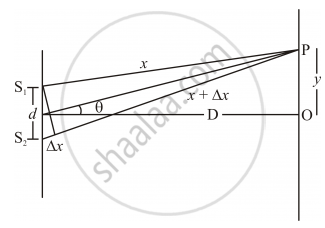
The two waves interfering at P have different distances S1P = x and S2P = x + Δx.
So, for the two sources S1 and S2we can respectively write,
`I_1 = I_(01) sin (kx -wt)`
`I_1 = I_(02) sin (k(x +Deltax)-wt) =I_(02)sin(kx -wt +delta)`
`delta = kDeltax =((2pi)/lambda) xx Delta x`
The resultant can be written as,
`I =I_0sin(kx -wt +epsi)
Where` I_0^2 =I_(01)^2 + I_(02)^2 +2I_(01) I_(02) cos delta`
And tan`epsi = I_(02) sin delta /(I_(01) +I_(02)cos delta)`
The condition for constructive (bright fringe) and destructive (dark fringe) interference are as follows;
δ = 2nπ for bright fringes
δ = (2n + 1) π for dark fringes
Where n is an integer.
Now to find the fringe width,
The path difference is `Deltax =S_2P-S_1P` nearly equal to d `sintheta =d tantheta =(dy)/D`
Hence we can write, `y=(nlambdaD)/d ,n` is an integer.
APPEARS IN
RELATED QUESTIONS
In Young's double slit experiment, derive the condition for
(i) constructive interference and
(ii) destructive interference at a point on the screen.
If the source of light used in a Young's double slit experiment is changed from red to violet, ___________ .
Two transparent slabs having equal thickness but different refractive indices µ1 and µ2are pasted side by side to form a composite slab. This slab is placed just after the double slit in a Young's experiment so that the light from one slit goes through one material and the light from the other slit goes through the other material. What should be the minimum thickness of the slab so that there is a minimum at the point P0 which is equidistant from the slits?
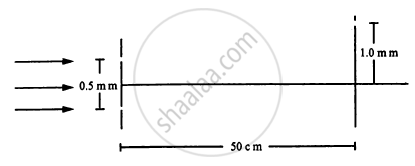
White coherent light (400 nm-700 nm) is sent through the slits of a Young's double slit experiment (see the following figure). The separation between the slits is 0⋅5 mm and the screen is 50 cm away from the slits. There is a hole in the screen at a point 1⋅0 mm away (along the width of the fringes) from the central line. (a) Which wavelength(s) will be absent in the light coming from the hole? (b) Which wavelength(s) will have a strong intensity?
Two balls are projected at an angle θ and (90° − θ) to the horizontal with the same speed. The ratio of their maximum vertical heights is:
In a Young’s double slit experiment, the source is white light. One of the holes is covered by a red filter and another by a blue filter. In this case ______.
Monochromatic green light of wavelength 5 × 10⁻⁷ m illuminates a pair of slits 1 mm apart. The separation of bright lines in the interference pattern formed on a screen 2 m away is ______.
- Assertion (A): In Young's double slit experiment all fringes are of equal width.
- Reason (R): The fringe width depends upon the wavelength of light (λ) used, the distance of the screen from the plane of slits (D) and slits separation (d).
What does \(x\) denote when deriving fringe positions?
What is the angular fringe width \(\alpha\)?
