Advertisements
Advertisements
प्रश्न
Two polaroids ‘A’ and ‘B’ are kept in crossed position. How should a third polaroid ‘C’ be placed between them so that the intensity of polarized light transmitted by polaroid B reduces to 1/8th of the intensity of unpolarized light incident on A?
Advertisements
उत्तर
Let θAC, angle between the transmission axis of Polaroid A and Polaroid C.
θCB, angle between the transmission axis of Polaroid C and Polaroid B.
Then,
θAC + θCB = 180° (As, Polaroid ‘A’ and ‘B’ are kept in crossed position.)
Or, θAC = 180° − θCB ... (1)
Intensity of unpolarized light = I0
I1, I2 and I3 are the intensities of light on passing through the A, B and C polarises respectively.
Now,
`I_1 = 1/2I_0 .....(2)`
`I_2 =I_1cos^2theta_(AC)`
=`1/2I_0cos^2theta_(AC)`
`= 1/2I_0 cos^2(180° -theta_(CB))` (from equation (1))
`I_2=1/2I_0sin^2theta_(CB)......... (3)`
and, `I_3 =I_2cos^2theta_(CB)`
`I_3=(1/2I_0sin^2theta_(CB)) cos^2theta_(CB)`
or,`I_3 = 1/2I_0sin_2theta_(CB)cos^2theta_(CB)`
As,given, `I_3=1/8 I_0`
Therefore,`1/8I_0 =1/2I_0 xx 1/4(sin2theta_(CB))^2`
`or, sin 2 theta_(CB =1)`
`or, 2theta_(CB) =90°`
`or, theta_(CB) =45°`
Thus, Polaroid ‘C’ must be placed at angle 45° with Polaroid ‘B’.
संबंधित प्रश्न
In Young' s experiment the ratio of intensity at the maxima and minima . in the interference pattern is 36 : 16. What is the ratio of the widths of the two slits?
Show that the angular width of the first diffraction fringe is half that of the central fringe.
A parallel beam of light of wavelength 500 nm falls on a narrow slit and the resulting diffraction pattern is observed on a screen 1 m away. It is observed that the first minimum is a distance of 2.5 mm away from the centre. Find the width of the slit.
Can we perform Young's double slit experiment with sound waves? To get a reasonable "fringe pattern", what should be the order of separation between the slits? How can the bright fringes and the dark fringes be detected in this case?
A Young's double slit apparatus has slits separated by 0⋅28 mm and a screen 48 cm away from the slits. The whole apparatus is immersed in water and the slits are illuminated by red light \[\left( \lambda = 700\text{ nm in vacuum} \right).\] Find the fringe-width of the pattern formed on the screen.
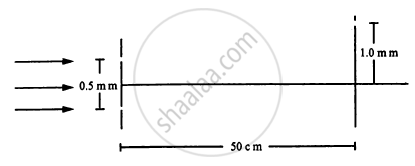
White coherent light (400 nm-700 nm) is sent through the slits of a Young's double slit experiment (see the following figure). The separation between the slits is 0⋅5 mm and the screen is 50 cm away from the slits. There is a hole in the screen at a point 1⋅0 mm away (along the width of the fringes) from the central line. (a) Which wavelength(s) will be absent in the light coming from the hole? (b) Which wavelength(s) will have a strong intensity?
Two slits in Young's interference experiment have width in the ratio 1 : 2. The ratio of intensity at the maxima and minima in their interference is ______.
Consider a two-slit interference arrangement (Figure) such that the distance of the screen from the slits is half the distance between the slits. Obtain the value of D in terms of λ such that the first minima on the screen falls at a distance D from the centre O.

In a Young's double slit experiment, the width of the one of the slit is three times the other slit. The amplitude of the light coming from a slit is proportional to the slit- width. Find the ratio of the maximum to the minimum intensity in the interference pattern.
Two beams of light having intensities I and 41 interfere to produce a fringe pattern on a screen. The phase difference between the two beams are π/2 and π/3 at points A and B respectively. The difference between the resultant intensities at the two points is xl. The value of x will be ______.
