Advertisements
Advertisements
प्रश्न
Two polaroids ‘A’ and ‘B’ are kept in crossed position. How should a third polaroid ‘C’ be placed between them so that the intensity of polarized light transmitted by polaroid B reduces to 1/8th of the intensity of unpolarized light incident on A?
Advertisements
उत्तर
Let θAC, angle between the transmission axis of Polaroid A and Polaroid C.
θCB, angle between the transmission axis of Polaroid C and Polaroid B.
Then,
θAC + θCB = 180° (As, Polaroid ‘A’ and ‘B’ are kept in crossed position.)
Or, θAC = 180° − θCB ... (1)
Intensity of unpolarized light = I0
I1, I2 and I3 are the intensities of light on passing through the A, B and C polarises respectively.
Now,
`I_1 = 1/2I_0 .....(2)`
`I_2 =I_1cos^2theta_(AC)`
=`1/2I_0cos^2theta_(AC)`
`= 1/2I_0 cos^2(180° -theta_(CB))` (from equation (1))
`I_2=1/2I_0sin^2theta_(CB)......... (3)`
and, `I_3 =I_2cos^2theta_(CB)`
`I_3=(1/2I_0sin^2theta_(CB)) cos^2theta_(CB)`
or,`I_3 = 1/2I_0sin_2theta_(CB)cos^2theta_(CB)`
As,given, `I_3=1/8 I_0`
Therefore,`1/8I_0 =1/2I_0 xx 1/4(sin2theta_(CB))^2`
`or, sin 2 theta_(CB =1)`
`or, 2theta_(CB) =90°`
`or, theta_(CB) =45°`
Thus, Polaroid ‘C’ must be placed at angle 45° with Polaroid ‘B’.
संबंधित प्रश्न
The intensity at the central maxima in Young’s double slit experiment is I0. Find out the intensity at a point where the path difference is` lambda/6,lambda/4 and lambda/3.`
In a double-slit experiment the angular width of a fringe is found to be 0.2° on a screen placed 1 m away. The wavelength of light used is 600 nm. What will be the angular width of the fringe if the entire experimental apparatus is immersed in water? Take refractive index of water to be 4/3.
The separation between the consecutive dark fringes in a Young's double slit experiment is 1.0 mm. The screen is placed at a distance of 2.5m from the slits and the separation between the slits is 1.0 mm. Calculate the wavelength of light used for the experiment.
Consider the arrangement shown in the figure. By some mechanism, the separation between the slits S3 and S4 can be changed. The intensity is measured at the point P, which is at the common perpendicular bisector of S1S2 and S2S4. When \[z = \frac{D\lambda}{2d},\] the intensity measured at P is I. Find the intensity when z is equal to
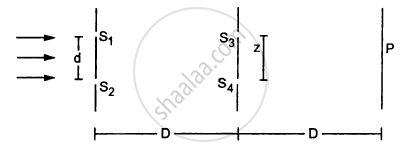
(a) \[\frac{D\lambda}{d}\]
(b) \[\frac{3D\lambda}{2d}\] and
(c) \[\frac{2D\lambda}{d}\]
In Young’s double-slit experiment, show that:
`beta = (lambda "D")/"d"` where the terms have their usual meaning.
Write the conditions on path difference under which constructive interference occurs in Young’s double-slit experiment.
In Young's double slit experiment the slits are 0.589 mm apart and the interference is observed on a screen placed at a distance of 100 cm from the slits. It is found that the 9th bright fringe is at a distance of 7.5 mm from the dark fringe which is second from the center of the fringe pattern. Find the wavelength of the light used.
In a Young’s double slit experiment, the source is white light. One of the holes is covered by a red filter and another by a blue filter. In this case ______.
The central fringe of the interference pattern produced by the light of wavelength 6000 Å is found to shift to the position of the fourth bright fringe after a glass plate of refractive index 1.5 is introduced in the path of one of the beams. The thickness of the glass plate would be ______.
What is required to obtain a clear interference pattern?
