Advertisements
Advertisements
प्रश्न
White light is used in a Young's double slit experiment. Find the minimum order of the violet fringe \[\left( \lambda = 400\text{ nm} \right)\] which overlaps with a red fringe \[\left( \lambda = 700\text{ nm} \right).\]
Advertisements
उत्तर
Let the separation between the slits be d and distance between screen from the slits be D.
Suppose, the mth bright fringe of violet light overlaps with the nth bright fringe of red light.
Now, the position of the mth bright fringe of violet light, yv = \[\frac{m \lambda_v D}{d}\]
Position of the nth bright fringe of red light, yr = \[\frac{n \lambda_r D}{d}\]
For overlapping, yv = yr
So, as per the question,
\[\frac{m \times 400 \times D}{d} = \frac{n \times 700 \times D}{d}\]
\[ \Rightarrow \frac{m}{n} = \frac{7}{4}\]
Therefore, the 7th bright fringe of violet light overlaps with the 4th bright fringe of red light.
It can also be seen that the 14th violet fringe will overlap with the 8th red fringe.
Because,
\[\frac{m}{n} = \frac{7}{4} = \frac{14}{8}\]
APPEARS IN
संबंधित प्रश्न
The ratio of the intensities at minima to the maxima in the Young's double slit experiment is 9 : 25. Find the ratio of the widths of the two slits.
In Young’s double slit experiment, show graphically how the intensity of light varies with distance
What is the effect on the interference fringes to a Young’s double slit experiment when
(i) the separation between the two slits is decreased?
(ii) the width of a source slit is increased?
(iii) the monochromatic source is replaced by a source of white light?
Justify your answer in each case.
The intensity at the central maxima in Young’s double slit experimental set-up is I0. Show that the intensity at a point where the path difference is λ/3 is I0/4.
If the separation between the slits in a Young's double slit experiment is increased, what happens to the fringe-width? If the separation is increased too much, will the fringe pattern remain detectable?
A Young's double slit apparatus has slits separated by 0⋅28 mm and a screen 48 cm away from the slits. The whole apparatus is immersed in water and the slits are illuminated by red light \[\left( \lambda = 700\text{ nm in vacuum} \right).\] Find the fringe-width of the pattern formed on the screen.
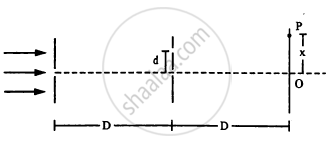
Consider the arrangement shown in the figure. The distance D is large compared to the separation d between the slits.
- Find the minimum value of d so that there is a dark fringe at O.
- Suppose d has this value. Find the distance x at which the next bright fringe is formed.
- Find the fringe-width.
In Young’s double-slit experiment, show that:
`beta = (lambda "D")/"d"` where the terms have their usual meaning.
In Young's double-slit experiment, the two slits are separated by a distance of 1.5 mm, and the screen is placed 1 m away from the plane of the slits. A beam of light consisting of two wavelengths of 650 nm and 520 nm is used to obtain interference fringes.
Find the distance of the third bright fringe for λ = 520 nm on the screen from the central maximum.
Write the conditions on path difference under which constructive interference occurs in Young’s double-slit experiment.
Wavefront is ______.
The force required to double the length of a steel wire of area 1 cm2, if its Young's modulus Y= 2 × 10¹¹/m2 is:
In Young's double slit experiment using light of wavelength 600 nm, the slit separation is 0.8 mm and the screen is kept 1.6 m from the plane of the slits. Calculate
- the fringe width
- the distance of (a) third minimum and (b) fifth maximum, from the central maximum.
Using Young’s double slit experiment, a monochromatic light of wavelength 5000Å produces fringes of fringe width 0.5 mm. If another monochromatic light of wavelength 6000Å is used and the separation between the slits is doubled, then the new fringe width will be ______.
In Young's double slit experiment the two slits are 0.6 mm distance apart. Interference pattern is observed on a screen at a distance 80 cm from the slits. The first dark fringe is observed on the screen directly opposite to one of the slits. The wavelength of light will be ______ nm.
In Young's double-slit experiment, the separation between the two slits is d and the distance of the screen from the slits is 1000 d. If the first minima fall at a distance d from the central maximum, obtain the relation between d and λ.
For small angles, what is the approximate path difference at a point a distance \(x\) from the central bright fringe?
What happens to fringe width when the screen distance increases while wavelength and slit separation remain unchanged?
What happens to fringe width when slit separation increases while wavelength and screen distance remain unchanged?
