Advertisements
Advertisements
प्रश्न
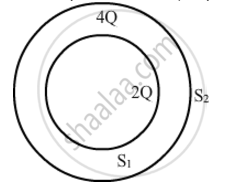
Consider two hollow concentric spheres, S1 and S2, enclosing charges 2Q and 4Q respectively as shown in the figure. (i) Find out the ratio of the electric flux through them. (ii) How will the electric flux through the sphere S1 change if a medium of dielectric constant 'εr' is introduced in the space inside S1 in place of air ? Deduce the necessary expression
Advertisements
उत्तर
(i) Charge enclosed by sphere S1 = 2Q
By Gauss law, electric flux through sphere S1 is
`phi_1=(2Q)/in_0`
Charge enclosed by sphere S2 = 2Q+4Q=6Q
`:.phi_2=(6Q)/in_0`
The ratio of the electric flux is
`phi_1/phi_2=((2Q)/in_0)/((6Q)/in_0)=2/6=1/3`
(ii) For sphere S1, the electric flux is
`phi'=(2q)/in_r`
`:.(phi')/phi_1=in_0/in_r`
`=>phi'=phi_1.in_0/in_r`
∵ εr > ε0
`:.phi'
Therefore, the electric flux through the sphere S1 decreases with the introduction of the dielectric inside it.
APPEARS IN
संबंधित प्रश्न
What is the electric flux through a cube of side 1 cm which encloses an electric dipole?
Careful measurement of the electric field at the surface of a black box indicates that the net outward flux through the surface of the box is 8.0 × 10³ N m2/C.
- What is the net charge inside the box?
- If the net outward flux through the surface of the box were zero, could you conclude that there were no charges inside the box? Why or Why not?
Given a uniform electric filed \[\vec{E} = 4 \times {10}^3 \ \hat{i} N/C\]. Find the flux of this field through a square of 5 cm on a side whose plane is parallel to the Y-Z plane. What would be the flux through the same square if the plane makes a 30° angle with the x-axis?
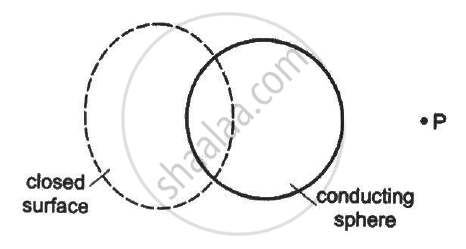
The following figure shows a closed surface that intersects a conducting sphere. If a positive charge is placed at point P, the flux of the electric field through the closed surface
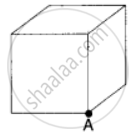
The total flux through the faces of the cube with side of length a if a charge q is placed at corner A of the cube is ______.
A hollow sphere of radius R has a point charge q at its centre. Electric flux emanating from the sphere is X. How will the electric flux change, if at all, when charge q is replaced by an electric dipole?
A hollow cylinder has a charge of 'q' C within it. If 𝜙 is the electric flux associated with the curved surface B, the flux linked with the plane surface A will be ______.

When the electric field direction is opposite to the area vector (θ = 180°), what is the flux?
What is the key difference between the flux formula for an open surface and a closed surface?
