Advertisements
Advertisements
Question
What is the effect on the interference fringes to a Young’s double slit experiment when
(i) the separation between the two slits is decreased?
(ii) the width of a source slit is increased?
(iii) the monochromatic source is replaced by a source of white light?
Justify your answer in each case.
Advertisements
Solution
(i) From the fringe width expression,
`beta =(lambdaD)/d`
With the decrease in separation between two slits, ‘d’ the fringe width increases.
(ii) For interference fringes to be seen
`s/S<lambda/d,`condition should be satisfied
Where, s = size of the source,
S = distance of the source from the plane of two slits.
As the source slit width increase, fringe pattern gets less and less sharp.
When the source slit is so wide the above condition does not satisfied and the interference pattern disappears.
(iii) The interference pattern due to different colour component of white light overlap. The central bright fringes for different colours are at the same position. Therefore central fringes are white. And on the either side of the central whit fringe coloured bands will appear.
The fringe closed on either side of central white fringe is red and the farthest will be blue. After a few fringes, no clear fringe pattern is seen.
RELATED QUESTIONS
Show that the angular width of the first diffraction fringe is half that of the central fringe.
The ratio of the intensities at minima to the maxima in the Young's double slit experiment is 9 : 25. Find the ratio of the widths of the two slits.
A thin transparent sheet is placed in front of a Young's double slit. The fringe-width will _____________ .
A source emitting light of wavelengths 480 nm and 600 nm is used in a double-slit interference experiment. The separation between the slits is 0.25 mm and the interference is observed on a screen placed at 150 cm from the slits. Find the linear separation between the first maximum (next to the central maximum) corresponding to the two wavelengths.
A double slit S1 − S2 is illuminated by a coherent light of wavelength \[\lambda.\] The slits are separated by a distance d. A plane mirror is placed in front of the double slit at a distance D1 from it and a screen ∑ is placed behind the double slit at a distance D2 from it (see the following figure). The screen ∑ receives only the light reflected by the mirror. Find the fringe-width of the interference pattern on the screen.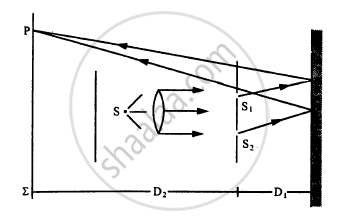
Wavefront is ______.
In a Young’s double slit experiment, the source is white light. One of the holes is covered by a red filter and another by a blue filter. In this case ______.
- Assertion (A): In Young's double slit experiment all fringes are of equal width.
- Reason (R): The fringe width depends upon the wavelength of light (λ) used, the distance of the screen from the plane of slits (D) and slits separation (d).
In Young's double-slit experiment, the separation between the two slits is d and the distance of the screen from the slits is 1000 d. If the first minima fall at a distance d from the central maximum, obtain the relation between d and λ.
What is the distance \\(x_n-x_m\\) between the \\(n\\)-th bright fringe and the \\(m\\)-th dark fringe?
