Advertisements
Advertisements
Question
In an interference experiment, a third bright fringe is obtained at a point on the screen with a light of 700 nm. What should be the wavelength of the light source in order to obtain the fifth bright fringe at the same point?
Options
420 nm
750 nm
630 nm
500 nm
Advertisements
Solution
420 nm
Explanation:
Position of nth bright fringe,
`y_n = (nlambdaD)/d`
Given: λ = 700 nm
∴ `y_3 = (3 xx 700 xx D)/d`
⇒ `y_3 = (2100D)/d`
The 5th bright fringe due to light of wavelength λ' is formed at y3,
∴ y5 = y3
or `(5 xx lambda^'D)/d = (2100 nmD)/d`
⇒ `lambda^' = 2100/5` = 420 nm
APPEARS IN
RELATED QUESTIONS
In Young' s experiment the ratio of intensity at the maxima and minima . in the interference pattern is 36 : 16. What is the ratio of the widths of the two slits?
Derive an expression for path difference in Young’s double slit experiment and obtain the conditions for constructive and destructive interference at a point on the screen.
In Young's double slit experiment, using monochromatic light of wavelength λ, the intensity of light at a point on the screen where path difference is λ, is K units. Find out the intensity of light at a point where path difference is `λ/3`.
Using analytical method for interference bands, obtain an expression for path difference between two light waves.
Write three characteristic features to distinguish between the interference fringes in Young's double slit experiment and the diffraction pattern obtained due to a narrow single slit.
A double slit S1 − S2 is illuminated by a coherent light of wavelength \[\lambda.\] The slits are separated by a distance d. A plane mirror is placed in front of the double slit at a distance D1 from it and a screen ∑ is placed behind the double slit at a distance D2 from it (see the following figure). The screen ∑ receives only the light reflected by the mirror. Find the fringe-width of the interference pattern on the screen.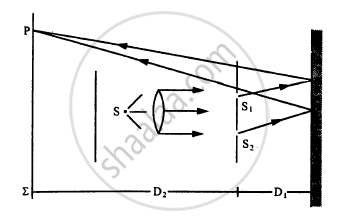
Wavefront is ______.
Two beams of light having intensities I and 41 interfere to produce a fringe pattern on a screen. The phase difference between the two beams are π/2 and π/3 at points A and B respectively. The difference between the resultant intensities at the two points is xl. The value of x will be ______.
What does \(\lambda\) denote in the fringe-position expressions?
For small angles, what is the approximate path difference at a point a distance \(x\) from the central bright fringe?
