Advertisements
Advertisements
Question
Draw a neat labelled diagram of Young’s Double Slit experiment. Show that `beta = (lambdaD)/d` , where the terms have their usual meanings (either for bright or dark fringe).
Advertisements
Solution

`PM_1 = x - d/2 and PM_2 = x + d/2`
In `DeltaS_2M_2P`
`(S_2P)^2 = (S_2M_2)^2 + (PM_2)^2`
`therefore (S_2P)^2 = D^2 + (x + d/2)^2` ....(i)
In `DeltaS_1M_1P`
`(S_1P)^2 = (S_1M_1)^2 + (PM_1)^2`
`therefore (S_1P)^2 = D^2 + (x - d/2)^2` ....(ii)
`(S_2P)^2 - (S_1P)^2 = D^2 + (x + d/2)^2 - D^2 - (x - d/2)^2`
`(S_2P - S_1P)(S_2P + S_1P) = x^2 + xd + d^2/4 - x^2 + xd - d^2/4`
`therefore S_2P - S_1P = (2xd)/(S_2P + S_1P)`
In practice, the distances x and d are very small as compared to D. To a first approximation we can write
`S_1P = S_2P = D or S_2P + S_1P = 2D`
`therefore` The path difference between two waves is given by
`S_2P - S_1P = (2xd)/(2D) = (xd)/D` .....(iii)
Now the intensity at P will be maximum or minimum according to the path difference. The point P will be bright if the path difference is an even multiple of `lambda/2` .
i.e. `S_2P - S_1P = (xd)/D = 2n(lambda/2)` ....(iv)
where n = 0,1,2,3, ...........
Or `x = n(lambdaD)/d` ....(v)
The Point P will be dark if the path difference is an odd multiple of
i.e. `S_2P - S_1P = (xd)/D = (2m - 1)lambda/2` ...(vi)
where m = 1,2,3, ...............
Or `x = (2m - 1) (lambdaD)/(2d)` ....(vii)
Expression for the band (fringe) width
The distance between the center of two adjcent bright or dark bands is called band width or fringe width.
Let `X_n` and `X_n+1` denotes the distances of `n^(th)` and `(n+1)^(th)` bright band on the same side of central
bright band, then from equation (v)
`X_n = n(lambdaD)/d`
`X_(n+1) = (n+1)(lambdaD)/d`
`X_(n+1) - X_n = (n+1-n)(lambdaD)/d`
`therefore beta = (lambdaD)/d` ...(viii)
APPEARS IN
RELATED QUESTIONS
In Young' s experiment the ratio of intensity at the maxima and minima . in the interference pattern is 36 : 16. What is the ratio of the widths of the two slits?
Show that the fringe pattern on the screen is actually a superposition of slit diffraction from each slit.
A beam of light consisting of two wavelengths, 650 nm and 520 nm, is used to obtain interference fringes in a Young’s double-slit experiment.
Find the distance of the third bright fringe on the screen from the central maximum for wavelength 650 nm.
The fringes produced in diffraction pattern are of _______.
(A) equal width with same intensity
(B) unequal width with varying intensity
(C) equal intensity\
(D) equal width with varying intensity
If the separation between the slits in a Young's double slit experiment is increased, what happens to the fringe-width? If the separation is increased too much, will the fringe pattern remain detectable?
A thin paper of thickness 0.02 mm having a refractive index 1.45 is pasted across one of the slits in a Young's double slit experiment. The paper transmits 4/9 of the light energy falling on it. (a) Find the ratio of the maximum intensity to the minimum intensity in the fringe pattern. (b) How many fringes will cross through the centre if an identical paper piece is pasted on the other slit also? The wavelength of the light used is 600 nm.
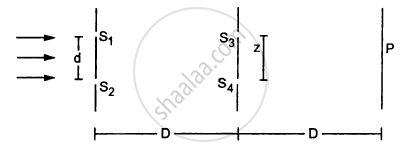
Consider the arrangement shown in the figure. By some mechanism, the separation between the slits S3 and S4 can be changed. The intensity is measured at the point P, which is at the common perpendicular bisector of S1S2 and S2S4. When \[z = \frac{D\lambda}{2d},\] the intensity measured at P is I. Find the intensity when z is equal to
(a) \[\frac{D\lambda}{d}\]
(b) \[\frac{3D\lambda}{2d}\] and
(c) \[\frac{2D\lambda}{d}\]
Two beams of light having intensities I and 41 interfere to produce a fringe pattern on a screen. The phase difference between the two beams are π/2 and π/3 at points A and B respectively. The difference between the resultant intensities at the two points is xl. The value of x will be ______.
In an interference experiment, a third bright fringe is obtained at a point on the screen with a light of 700 nm. What should be the wavelength of the light source in order to obtain the fifth bright fringe at the same point?
What is the fringe width \(\beta\) in Young's double-slit experiment?
