Advertisements
Advertisements
Question
- Assertion (A): In Young's double slit experiment all fringes are of equal width.
- Reason (R): The fringe width depends upon the wavelength of light (λ) used, the distance of the screen from the plane of slits (D) and slits separation (d).
Options
Both Assertion (A) and Reason (R) are true and Reason (R) is the correct explanation of Assertion (A).
Both Assertion (A) and Reason (R) are true and Reason (R) is NOT the correct explanation of Assertion (A).
Assertion (A) is true and Reason (R) is false.
Assertion (A) is false and Reason (R) is also false.
Advertisements
Solution
Both Assertion (A) and Reason (R) are true and Reason (R) is the correct explanation of Assertion (A).
Explanation:
Bright and dark fringes are produced as light travels through a slit in Young's double-slit experiment. Both the black and brilliant fringes are the same width as YDSE.
Statement 2 explanation: White light is used in Young's double-slit studies, and it is directed through the slit. Therefore, only brilliant and dark fringes may be seen utilising this source.
We know that fringe width is given by,
Width = `(lambdaD)/d`
Where,
λ = Wavelength of source used.
D = Distance between screen and slit.
d = Distance between slits.
As fringe width depends on all these factors so the fringe width remains constant.
APPEARS IN
RELATED QUESTIONS
Write two characteristics features distinguish the diffractions pattern from the interference fringes obtained in Young’s double slit experiment.
In Young's double slit experiment, derive the condition for
(i) constructive interference and
(ii) destructive interference at a point on the screen.
The intensity at the central maxima in Young’s double slit experimental set-up is I0. Show that the intensity at a point where the path difference is λ/3 is I0/4.
A Young's double slit experiment is performed with white light.
(a) The central fringe will be white.
(b) There will not be a completely dark fringe.
(c) The fringe next to the central will be red.
(d) The fringe next to the central will be violet.
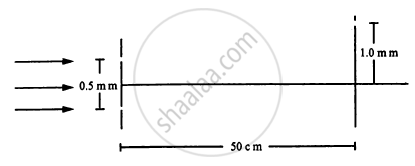
White coherent light (400 nm-700 nm) is sent through the slits of a Young's double slit experiment (see the following figure). The separation between the slits is 0⋅5 mm and the screen is 50 cm away from the slits. There is a hole in the screen at a point 1⋅0 mm away (along the width of the fringes) from the central line. (a) Which wavelength(s) will be absent in the light coming from the hole? (b) Which wavelength(s) will have a strong intensity?
In Young's double slit experiment using monochromatic light of wavelength 600 nm, 5th bright fringe is at a distance of 0·48 mm from the centre of the pattern. If the screen is at a distance of 80 cm from the plane of the two slits, calculate:
(i) Distance between the two slits.
(ii) Fringe width, i.e. fringe separation.
Write the conditions on path difference under which constructive interference occurs in Young’s double-slit experiment.
Wavefront is ______.
Why does the phase difference between light from ordinary sources change randomly?
What is the interference pattern observed on the screen in Young's double-slit experiment?
