Advertisements
Advertisements
Question
- Assertion (A): Work done in moving a charge around a closed path, in an electric field is always zero.
- Reason (R): Electrostatic force is a conservative force.
Options
Both Assertion (A) and Reason (R) are true and Reason (R) is the correct explanation of Assertion (A).
Both Assertion (A) and Reason (R) are true and Reason (R) is NOT the correct explanation of Assertion (A).
Assertion (A) is true and Reason (R) is false.
Assertion (A) is false and Reason (R) is also false.
Advertisements
Solution
Both Assertion (A) and Reason (R) are true and Reason (R) is the correct explanation of Assertion (A).
Explanation:
Because the electrostatic force is a conservative force, there is never any work involved in relocating a charge along a closed path in an electric field. A force that conserves mechanical energy is referred to as conservative. The electrostatic force is a force that simply depends on the position of the charges, not their velocity. Therefore, the electrostatic force's effort in transporting a charge along a closed path depends only on the charge's initial and final positions and is independent of the path travelled.
APPEARS IN
RELATED QUESTIONS
If one of the two electrons of a H2 molecule is removed, we get a hydrogen molecular ion `"H"_2^+`. In the ground state of an `"H"_2^+`, the two protons are separated by roughly 1.5 Å, and the electron is roughly 1 Å from each proton. Determine the potential energy of the system. Specify your choice of zero potential energy.
Four point charges Q, q, Q and q are placed at the corners of a square of side 'a' as shown in the figure.
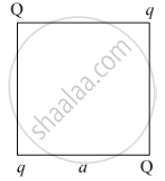
Find the
1) resultant electric force on a charge Q, and
2) potential energy of this system.
A point charge Q is placed at point O as shown in the figure. The potential difference VA – VB positive. Is the charge Q negative or positive?
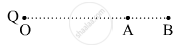
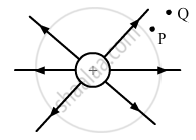
Figure shows the field lines due to a positive point charge. Give the sign of potential energy difference of a small negative charge between the points Q and P.
1 volt is equivalent to ______.
The work done in bringing a unit positive charge from infinite distance to a point at distance x from a positive charge Q is W. Then the potential at that point is ______.
Consider a uniform electric field in the z-direction. The potential is a constant ______.
- Assertion (A): An electron has a high potential energy when it is at a location associated with a more negative value of potential, and a low potential energy when at a location associated with a more positive potential.
- Reason (R): Electrons move from a region of higher potential to region of lower potential.
Select the most appropriate answer from the options given below:
- In a quark model of elementary particles, a neutron is made of one up quarks [charge (2/3) e] and two down quarks [charges –(1/3) e]. Assume that they have a triangle configuration with side length of the order of 10–15 m. Calculate electrostatic potential energy of neutron and compare it with its mass 939 MeV.
- Repeat above exercise for a proton which is made of two up and one down quark.
Charges (+q) and (–q) are placed at points A and B respectively which are a distance 2L apart. C is the midpoint between A and B. What is the work done in moving a charge +Q along the semicircle CRD?

