Advertisements
Advertisements
Question
- Assertion (A): An electron has a high potential energy when it is at a location associated with a more negative value of potential, and a low potential energy when at a location associated with a more positive potential.
- Reason (R): Electrons move from a region of higher potential to region of lower potential.
Select the most appropriate answer from the options given below:
Options
Both A and R are true and R is the correct explanation of A.
Both A and R are true but R is not the correct explanation of A.
A is true but R is false.
A is false and R is also false.
Advertisements
Solution
A is true but R is false.
Explanation:
When an electron is at a location associated with a negative value of potential, say -V, its potential energy is U = (-e)(-V) = eV. When an electron is at a location associated with a positive potential, say +V, its potential energy is U = (-e)(+V) = -eV. So, the assertion is true.
From higher to lower potential, current flows. Conventionally, electrons move from a lower to a greater potential when they flow in the opposite manner. So, the reason is false.
APPEARS IN
RELATED QUESTIONS
Four point charges Q, q, Q and q are placed at the corners of a square of side 'a' as shown in the figure.
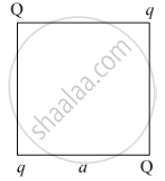
Find the
1) resultant electric force on a charge Q, and
2) potential energy of this system.
Find out the amount of the work done to separate the charges at infinite distance.
If a charge q0 is there in an electric field caused by several point charges qi. The potential energy of q0 is given by ________.
The work done in bringing a unit positive charge from infinite distance to a point at distance x from a positive charge Q is W. Then the potential at that point is ______.
Charges (+q) and (–q) are placed at points A and B respectively which are a distance 2L apart. C is the midpoint between A and B. What is the work done in moving a charge +Q along the semicircle CRD?

The symbol, SI unit, and nature of electrostatic potential energy are respectively:
If a system of like charges, assembled by doing work against their repulsive force, is released, the stored electrostatic potential energy:
While assembling a system of charges, the work done in bringing the first charge \[q_1\] from infinity to its Position 1 is:
For a system of n charges, the total number of unique charge pairs whose potential energies must be summed is:
For two like charges (both positive or both negative), the sign of \[(q_1 q_2)\] and the resulting sign of the potential energy U are:
