Advertisements
Advertisements
Question
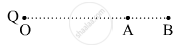
A point charge Q is placed at point O as shown in the figure. The potential difference VA – VB positive. Is the charge Q negative or positive?
Advertisements
Solution
According to the question, VA – VB is positive, which leads to the conclusion that VA > VB , since potential inversely proportional to distance from the charge (\[V \propto \frac{1}{r}\]). Thus, charge at O is positive.
APPEARS IN
RELATED QUESTIONS
A cube of side b has a charge q at each of its vertices. Determine the potential and electric field due to this charge array at the centre of the cube.
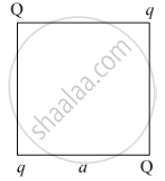
Four point charges Q, q, Q and q are placed at the corners of a square of side 'a' as shown in the figure.
Find the
1) resultant electric force on a charge Q, and
2) potential energy of this system.
1 volt is equivalent to ______.
Charges (+q) and (–q) are placed at points A and B respectively which are a distance 2L apart. C is the midpoint between A and B. What is the work done in moving a charge +Q along the semicircle CRD?

If a system of like charges, assembled by doing work against their repulsive force, is released, the stored electrostatic potential energy:
For a system of unlike charges (attractive force), an external agent must do work to separate them because the system:
While assembling a system of charges, the work done in bringing the first charge \[q_1\] from infinity to its Position 1 is:
The total electrostatic potential energy of a three-charge system is:
For n charges \[q_1, q_2, \ldots, q_n\] at positions \[r_1, r_2, \ldots, r_n\], where \[r_{ij}\] is the distance between charge i and charge j, the total electrostatic potential energy of the system is:
For the symmetrical arrangement of charges +q, -q, +q, -q at the corners of a square, the electric potential at the centre E due to the four charges is:
