Advertisements
Advertisements
Question
Justify your answers for each case.
State the significance of the negative value of electrostatic potential energy of a system of charges.
Three charges are placed at the corners of an equilateral triangle ABC of side 2.0 m as shown in the figure. Calculate the electric potential energy of the system of three charges.

Advertisements
Solution
U = `(KQ_AQ_B)/r + (KQ_BQ_C)/r + (KQ_CQ_A)/r`
U = `K/r[Q_AQ_B + Q_BQ_C + Q_CQ_A]`
U = `K/r xx [4 xx 10^-6 xx -4 xx 10^-6] + [-4 xx 10^-6 xx 2 xx 10^-6] + [2 xx 10^-6 xx 4 xx 10^-6]`
U = `K/r xx 10^-12[-16 - 8 + 8]`
U = `K/r xx 10^-12(-16)`
U = `(-9 xx 10^9 xx 10^-12 xx 16)/2`
U = -72 × 10-3 J
U = -7.2 × 10⁻² J
A negative value signifies a stable system.
APPEARS IN
RELATED QUESTIONS
Find out the amount of the work done to separate the charges at infinite distance.
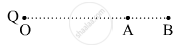
A point charge Q is placed at point O as shown in the figure. The potential difference VA – VB positive. Is the charge Q negative or positive?
Consider a uniform electric field in the z-direction. The potential is a constant ______.
Calculate potential energy of a point charge – q placed along the axis due to a charge +Q uniformly distributed along a ring of radius R. Sketch P.E. as a function of axial distance z from the centre of the ring. Looking at graph, can you see what would happen if – q is displaced slightly from the centre of the ring (along the axis)?
Charges (+q) and (–q) are placed at points A and B respectively which are a distance 2L apart. C is the midpoint between A and B. What is the work done in moving a charge +Q along the semicircle CRD?

The symbol, SI unit, and nature of electrostatic potential energy are respectively:
For a system of unlike charges (attractive force), an external agent must do work to separate them because the system:
While assembling a system of charges, the work done in bringing the first charge \[q_1\] from infinity to its Position 1 is:
The work done in bringing charge \[q_2\] from infinity to Position 2, in the electric potential \[V_1\] produced by the fixed charge \[q_1\] at separation \[r_{12}\], is:
For the symmetrical arrangement of charges +q, -q, +q, -q at the corners of a square, the electric potential at the centre E due to the four charges is:
