Advertisements
Advertisements
Question
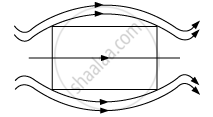
Depict the behaviour of magnetic field lines in the presence of a diamagnetic material?
Advertisements
Solution
When a diamagnetic material is placed in an external magnetic field, the field lines are repelled or expelled. They are represented as follows:
APPEARS IN
RELATED QUESTIONS
Two identical coils P and Q each of radius R are lying in perpendicular planes such that they have a common centre. Find the magnitude and direction of the magnetic field at the common centre of the two coils, if they carry currents equal to I and \[\sqrt{3}\] I respectively.

The motion of copper plate is damped when it is allowed to oscillate between the two poles of a magnet. What is the cause of this damping?
Two proton beams going in the same direction repel each other whereas two wires carrying currents in the same direction attract each other. Explain.
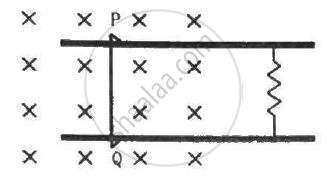
Consider the situation shown in figure. The wire PQ has mass m, resistance r and can slide on the smooth, horizontal parallel rails separated by a distance l. The resistance of the rails is negligible. A uniform magnetic field B exists in the rectangular region and a resistance R connects the rails outside the field region. At t = 0, the wire PQ is pushed towards right with a speed v0. Find (a) the current in the loop at an instant when the speed of the wire PQ is v, (b) the acceleration of the wire at this instant, (c) the velocity vas a functions of x and (d) the maximum distance the wire will move.
Assertion(A): A proton and an electron, with same momenta, enter in a magnetic field in a direction at right angles to the lines of the force. The radius of the paths followed by them will be same.
Reason (R): Electron has less mass than the proton.
Select the most appropriate answer from the options given below:
A beam of protons with speed 4 × 10⁵ ms-1 enters a uniform magnetic field of 0.3 T at an angle of 60° to the magnetic field. The pitch of the resulting helical path of protons is close to :
(Mass of the proton = 1.67 × 10⁻²⁷ kg, charge of the proton = 1.69 × 10⁻¹⁹ C)
A charge Q is moving `vec"dl"` distance in the magnetic field `vec"B"`. Find the value of work done by `vec"B"`.
Protons and singly ionized atoms of U235 and U238 are passed in turn (which means one after the other and not at the same time) through a velocity selector and then enter a uniform magnetic field. The protons describe semicircles of radius 10 mm. The separation between the ions of U235 and U238 after describing the semicircle is given by ______.
Which of the following statements about the magnetic force and electric force is TRUE regarding energy transfer to a charged particle?
The angular frequency of revolution of a charged particle in a magnetic field is given by:
