Advertisements
Advertisements
Question
The motion of copper plate is damped when it is allowed to oscillate between the two poles of a magnet. What is the cause of this damping?
Advertisements
Solution
As the copper plates oscillate in the magnetic field between the two poles of the magnet, there is a continuous change of magnetic field flux linked with the plate. Due to this, eddy currents are set up in the copper plate which try to oppose the motion of the plate according to the Lenz’s law and finally bring it to rest.
RELATED QUESTIONS
Show with the help of a diagram how the force between the two conductors would change when the currents in them flow in the opposite directions?
A moving charge produces
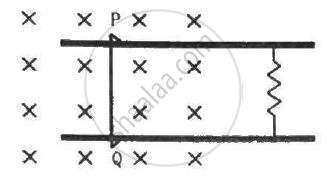
Consider the situation shown in figure. The wire PQ has mass m, resistance r and can slide on the smooth, horizontal parallel rails separated by a distance l. The resistance of the rails is negligible. A uniform magnetic field B exists in the rectangular region and a resistance R connects the rails outside the field region. At t = 0, the wire PQ is pushed towards right with a speed v0. Find (a) the current in the loop at an instant when the speed of the wire PQ is v, (b) the acceleration of the wire at this instant, (c) the velocity vas a functions of x and (d) the maximum distance the wire will move.
A moving charge will gain kinetic energy due to the application of ______.
A charged particle moving in a magnetic field experiences a resultant force ______
A beam of protons with speed 4 × 10⁵ ms-1 enters a uniform magnetic field of 0.3 T at an angle of 60° to the magnetic field. The pitch of the resulting helical path of protons is close to :
(Mass of the proton = 1.67 × 10⁻²⁷ kg, charge of the proton = 1.69 × 10⁻¹⁹ C)
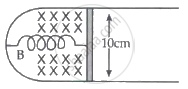
A thin strip 10 cm long is on a U-shaped wire of negligible resistance and it is connected to a spring of spring constant 0.5 Nm-1. The assembly is kept in a uniform magnetic field of 0.1 T. If the strip is pulled from its equilibrium position and released, the number of oscillations it performs before its amplitude decreases by a factor of e is N. If the mass of the strip is 50 grams, its resistance is 10 Ω, and air drag is negligible, N will be close to ______.
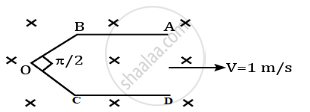
A conductor ABOCD moves along its bisector with a velocity 1 m/s through a perpendicular magnetic field of 1 wb/m2, as shown in figure. If all the four sides are 1 m length each, then the induced emf between A and Din approx is ______V.
A charged particle of charge q and mass m is projected in a region that contains an electric and magnetic field as shown in the figure with velocity V at an angle of 45° with x-direction. If V = `sqrt((qE)/m)`, then net deviation in particle motion will be (neglect the effect of gravity) in a clockwise direction approx ______ °.

Which property of the cyclotron motion of a charged particle in a magnetic field forms the basis of particle accelerators?
