Advertisements
Advertisements
Question
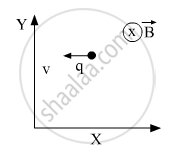
If an electric field \[\vec{E}\] is also applied such that the particle continues moving along the original straight line path, what should be the magnitude and direction of the electric field \[\vec{E}\] ?
Advertisements
Solution
The direction of the magnetic force is along negative Y-axis and so, the direction of electric force should be along the positive Y-axis to counter balance the magnetic force and charge particle will move in the straight line path.
Therefore, the direction of electric field is along the positive Y-axis and its magnitude is given by E = vB
APPEARS IN
RELATED QUESTIONS
Sketch a schematic diagram depicting oscillating electric and magnetic fields of an em wave propagating along + z-direction ?
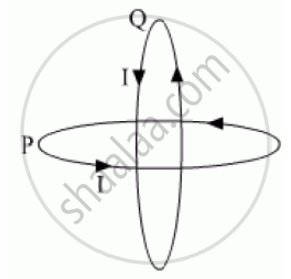
Two identical circular wires P and Q each of radius R and carrying current ‘I’ are kept in perpendicular planes such that they have a common centre as shown in the figure. Find the magnitude and direction of the net magnetic field at the common centre of the two coils.
Consider a long, straight wire of cross-sectional area A carrying a current i. Let there be n free electrons per unit volume. An observer places himself on a trolley moving in the direction opposite to the current with a speed \[v = \frac{i}{\text{nAe}}\] and separation from the wire by a distance r. The magnetic field seen by the observer is very nearly
The current generator Ig' shown in figure, sends a constant current i through the circuit. The wire ab has a length l and mass m and can slide on the smooth, horizontal rails connected to Ig. The entire system lies in a vertical magnetic field B. Find the velocity of the wire as a function of time.
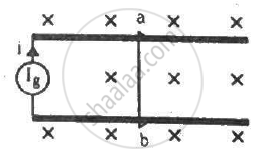
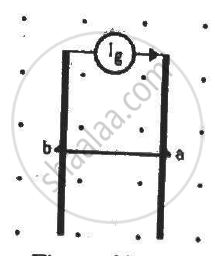
The current generator Ig' shown in figure, sends a constant current i through the circuit. The wire ab has a length l and mass m and can slide on the smooth, horizontal rails connected to Ig. The entire system lies in a vertical magnetic field B. The system is kept vertically in a uniform horizontal magnetic field B that is perpendicular to the plane of the rails (figure). It is found that the wire stays in equilibrium. If the wire ab is replaced by another wire of double its mass, how long will it take in falling through a distance equal to its length?
A magnetic field that varies in magnitude from point to point but has a constant direction (east to west) is set up in a chamber. A charged particle enters the chamber and travels undeflected along a straight path with constant speed. What can you say about the initial velocity of the particle?
If an electron is moving with velocity `vecnu` produces a magnetic field `vec"B"`, then ______.
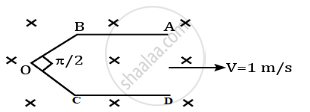
A conductor ABOCD moves along its bisector with a velocity 1 m/s through a perpendicular magnetic field of 1 wb/m2, as shown in figure. If all the four sides are 1 m length each, then the induced emf between A and Din approx is ______V.
A particle of mass m and charge q moves with speed v perpendicular to a magnetic field B. Equating the magnetic force to the centripetal force, the radius of the circular path is:
The time period of revolution of a charged particle in a uniform magnetic field is:
