Advertisements
Advertisements
प्रश्न
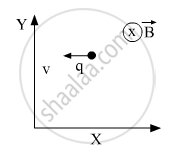
If an electric field \[\vec{E}\] is also applied such that the particle continues moving along the original straight line path, what should be the magnitude and direction of the electric field \[\vec{E}\] ?
Advertisements
उत्तर
The direction of the magnetic force is along negative Y-axis and so, the direction of electric force should be along the positive Y-axis to counter balance the magnetic force and charge particle will move in the straight line path.
Therefore, the direction of electric field is along the positive Y-axis and its magnitude is given by E = vB
APPEARS IN
संबंधित प्रश्न
Depict the behaviour of magnetic field lines in the presence of a diamagnetic material?
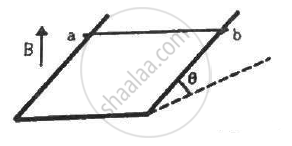
A wire ab of length l, mass m and resistance R slides on a smooth, thick pair of metallic rails joined at the bottom as shown in figure. The plane of the rails makes an angle θ with the horizontal. A vertical magnetic field B exists in the region. If the wire slides on the rails at a constant speed v, show that \[B = \sqrt{\frac{mg R sin\theta}{v l^2 \cos^2 \theta}}\]
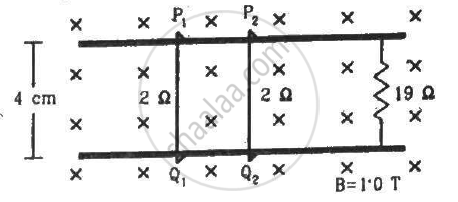
Consider the situation shown in figure. The wires P1Q1 and P2Q2 are made to slide on the rails with the same speed 5 cm s−1. Suppose the 19 Ω resistor is disconnected. Find the current through P2Q2 if (a) both the wires move towards right and (b) if P1Q1 moves towards left but P2Q2 moves towards right.
If an electron is moving with velocity `vecnu` produces a magnetic field `vec"B"`, then ______.
Assertion(A): A proton and an electron, with same momenta, enter in a magnetic field in a direction at right angles to the lines of the force. The radius of the paths followed by them will be same.
Reason (R): Electron has less mass than the proton.
Select the most appropriate answer from the options given below:
A deuteron and an alpha particle having equal kinetic energy enter perpendicular into a magnetic field. Let `r_d` and `r_alpha` be their respective radii of the circular path. The value of `(r_d)/(r_alpha)` is equal to ______.
A circular coil of radius 10 cm is placed in a uniform magnetic field of 3.0 × 10⁻⁵ T with its plane perpendicular to the field initially. It is rotated at constant angular speed about an axis along the diameter of coil and perpendicular to magnetic field so that it undergoes half of rotation in 0.2 s. The maximum value of EMF induced (in µV) in the coil will be close to the integer ______.
Which property of the cyclotron motion of a charged particle in a magnetic field forms the basis of particle accelerators?
A charged particle's velocity makes an angle θ with a magnetic field \[\vec B\], where 0° < θ < 90°. The perpendicular component of velocity \[v_\perp = v \sin\theta\] is responsible for:
An electron moves at \[3 \times 10^7\] m/s in a circular path of radius 0.28 m in a magnetic field. Its frequency of revolution is approximately:
