Advertisements
Advertisements
प्रश्न
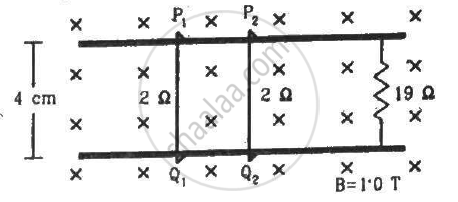
Consider the situation shown in figure. The wires P1Q1 and P2Q2 are made to slide on the rails with the same speed 5 cm s−1. Suppose the 19 Ω resistor is disconnected. Find the current through P2Q2 if (a) both the wires move towards right and (b) if P1Q1 moves towards left but P2Q2 moves towards right.
Advertisements
उत्तर
(a) When the wires move in the same direction, their polarity remains the same. The circuit remains incomplete. Therefore, no current flows in the circuit.
(b) When the wires move in opposite directions, their polarities are reversed. Thus, current flows in the circuit.
\[V_{P_2 Q_2} = Blv\]
= 1 × 0.04 × 0.05
= 2 × 10⁻³ V
R = 2 Ω
Current in the circuit is given by
\[i = \frac{2 \times {10}^{- 3}}{2}\]
= 1 × 10⁻³ A = 1 mA
APPEARS IN
संबंधित प्रश्न
Find the condition under which the charged particles moving with different speeds in the presence of electric and magnetic field vectors can be used to select charged particles of a particular speed.
A point charge q moving with speed v enters a uniform magnetic field B that is acting into the plane of the paper as shown. What is the path followed by the charge q and in which plane does it move?
Show with the help of a diagram how the force between the two conductors would change when the currents in them flow in the opposite directions?
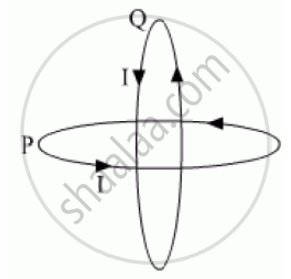
Two identical circular wires P and Q each of radius R and carrying current ‘I’ are kept in perpendicular planes such that they have a common centre as shown in the figure. Find the magnitude and direction of the net magnetic field at the common centre of the two coils.
A moving charge produces
A charged particle moves through a magnetic field perpendicular to its direction. Then ______.
-
The presence of a large magnetic flux through a coil maintains a current in the coil if the circuit is continuous.
-
A coil of a metal wire kept stationary in a non– uniform magnetic field has an e.m.f induced in it.
-
A charged particle enters a region of uniform magnetic field at an angle of 85° to the magnetic lines of force, the path of the particle is a circle.
-
There is no change in the energy of a charged particle moving in a magnetic field although a magnetic force is acting on it.
Assertion(A): A proton and an electron, with same momenta, enter in a magnetic field in a direction at right angles to the lines of the force. The radius of the paths followed by them will be same.
Reason (R): Electron has less mass than the proton.
Select the most appropriate answer from the options given below:
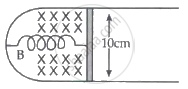
A thin strip 10 cm long is on a U-shaped wire of negligible resistance and it is connected to a spring of spring constant 0.5 Nm-1. The assembly is kept in a uniform magnetic field of 0.1 T. If the strip is pulled from its equilibrium position and released, the number of oscillations it performs before its amplitude decreases by a factor of e is N. If the mass of the strip is 50 grams, its resistance is 10 Ω, and air drag is negligible, N will be close to ______.
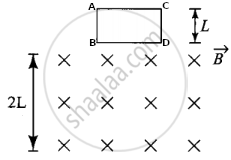
A square coil ABCD with its plane vertical is released from rest in a horizontal uniform magnetic field `vec"B"` of length 2L. The acceleration of the coil is ______.
An α particle is moving along a circle of radius R with a constant angular velocity ω. Point A lies in the same plane at a distance 2R from the centre. Point A records magnetic field produced by α particle, if the minimum time interval between two successive times at which A records zero magnetic field is 't' the angular speed ω, in terms of t is ______.
A charge Q is moving `vec"dl"` distance in the magnetic field `vec"B"`. Find the value of work done by `vec"B"`.
Protons and singly ionized atoms of U235 and U238 are passed in turn (which means one after the other and not at the same time) through a velocity selector and then enter a uniform magnetic field. The protons describe semicircles of radius 10 mm. The separation between the ions of U235 and U238 after describing the semicircle is given by ______.
The work done by the magnetic force on a moving charged particle is:
A charged particle enters a magnetic field \[\vec B\] with velocity \[\vec v\] such that the angle between them is 90°. What type of path does the particle follow?
The frequency of revolution of a charged particle moving in a circular path in a magnetic field is:
Which property of the cyclotron motion of a charged particle in a magnetic field forms the basis of particle accelerators?
