Advertisements
Advertisements
प्रश्न
Show with the help of a diagram how the force between the two conductors would change when the currents in them flow in the opposite directions?
Advertisements
उत्तर
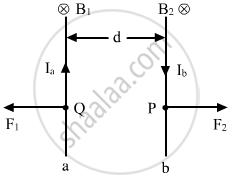
Now, let the direction of current in conductor b be reversed. The magnetic field B2 at point P due to current Ia flowing through a will be downwards. Similarly, the magnetic field B1 at point Q due to current Ib passing through b will also be downwards as shown. The force on a will be, therefore, towards the left. Also, the force on b will be towards the right. Hence, the two conductors will repel each other as shown.
संबंधित प्रश्न
Find the condition under which the charged particles moving with different speeds in the presence of electric and magnetic field vectors can be used to select charged particles of a particular speed.
A point charge q moving with speed v enters a uniform magnetic field B that is acting into the plane of the paper as shown. What is the path followed by the charge q and in which plane does it move?
Sketch a schematic diagram depicting oscillating electric and magnetic fields of an em wave propagating along + z-direction ?
The motion of copper plate is damped when it is allowed to oscillate between the two poles of a magnet. What is the cause of this damping?
A magnetic field that varies in magnitude from point to point but has a constant direction (east to west) is set up in a chamber. A charged particle enters the chamber and travels undeflected along a straight path with constant speed. What can you say about the initial velocity of the particle?
A circular coil of radius 10 cm is placed in a uniform magnetic field of 3.0 × 10⁻⁵ T with its plane perpendicular to the field initially. It is rotated at constant angular speed about an axis along the diameter of coil and perpendicular to magnetic field so that it undergoes half of rotation in 0.2 s. The maximum value of EMF induced (in µV) in the coil will be close to the integer ______.
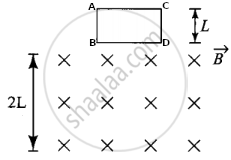
A square coil ABCD with its plane vertical is released from rest in a horizontal uniform magnetic field `vec"B"` of length 2L. The acceleration of the coil is ______.
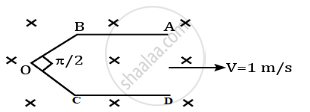
A conductor ABOCD moves along its bisector with a velocity 1 m/s through a perpendicular magnetic field of 1 wb/m2, as shown in figure. If all the four sides are 1 m length each, then the induced emf between A and Din approx is ______V.
An electron (mass 9 × 10⁻³¹ kg and charge 1.6 × 10⁻¹⁹ C) moving with speed c/100 (c = speed of light)is injected into a magnetic field `vecB` of magnitude 9 × 10⁻⁴ T perpendicular to its direction of motion. We wish to apply an uniform electric field `vecE` together with the magnetic field so that the electron does not deflect from its path. Then (speed of light c = 3 × 10⁸ m s−1).
An electron (mass \[9 \times 10^{-31}\] kg, charge \[1.6 \times 10^{-19}\] C) moves at \[3 \times 10^7\] m/s in a magnetic field of \[6 \times 10^{-4}\] T perpendicular to its velocity. The radius of its circular path is:
