Advertisements
Advertisements
प्रश्न
Two long straight parallel conductors 'a' and 'b', carrying steady currents Ia and Ib are separated by a distance d. Write the magnitude and direction of the magnetic field produced by the conductor 'a' at the points along the conductor 'b'. If the currents are flowing in the same direction, what is the nature and magnitude of the force between the two conductors?
Advertisements
उत्तर
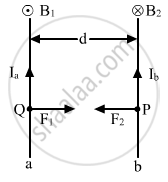
Let a and b be long straight parallel conductors. Ia and Ib are the current flowing through them and are separated by a distance d.
Magnetic field induction at a point P on a conductor b due to current Ia passing through a is
\[B_1 = \frac{\mu_0 2 I_a}{4\pi d}\]
Now, unit length of b will experience a force as
\[F_2 = B_1 I_b \times 1 = B_1 I_b \]
\[ \therefore F_2 = \frac{\mu_0}{4\pi}\frac{2 I_a I_b}{d}\]
Conductor a also experiences the same amount of force, directed towards b. Hence, a and b attract each other.
संबंधित प्रश्न
A copper wire of diameter 1.6 mm carries a current of 20 A. Find the maximum magnitude of the magnetic field `vecB` due to this current.
A straight wire of length l can slide on two parallel plastic rails kept in a horizontal plane with a separation d. The coefficient of friction between the wire and the rails is µ. If the wire carries a current i, what minimum magnetic field should exist in the space in order to slide the wire on the rails?
A rectangular coil of 100 turns has length 5 cm and width 4 cm. It is placed with its plane parallel to a uniform magnetic field and a current of 2 A is sent through the coil. Find the magnitude of the magnetic field B if the torque acting on the coil is 0.2 N m−1
A straight, how wire carries a current of 20 A. Another wire carrying equal current is placed parallel to it. If the force acting on a length of 10 cm of the second wire is 2.0 × 10⁻⁵ N, what is the separation between them?
Three coplanar parallel wires, each carrying a current of 10 A along the same direction, are placed with a separation 5.0 cm between the consecutive ones. Find the magnitude of the magnetic force per unit length acting on the wires.
Three infinitely long parallel straight current-carrying wires A, B and C are kept at equal distance from each other as shown in the figure. The wire C experiences net force F. The net force on wire C, when the current in wire A is reversed will be ______.

Equal currents are passing through two very long and straight parallel wires in the same direction. They will ______
The force per unit length between two long parallel current-carrying conductors carrying currents I₁ and I₂, separated by a perpendicular distance d, is given by:
If the current Ia in conductor a is doubled while Ib and the distance d remain unchanged, the force per unit length F/L between the conductors:
If the perpendicular distance d between two parallel current-carrying conductors is doubled, the force per unit length F/L:
