Advertisements
Advertisements
प्रश्न
Two long straight parallel conductors 'a' and 'b', carrying steady currents Ia and Ib are separated by a distance d. Write the magnitude and direction of the magnetic field produced by the conductor 'a' at the points along the conductor 'b'. If the currents are flowing in the same direction, what is the nature and magnitude of the force between the two conductors?
Advertisements
उत्तर
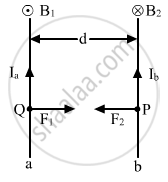
Let a and b be long straight parallel conductors. Ia and Ib are the current flowing through them and are separated by a distance d.
Magnetic field induction at a point P on a conductor b due to current Ia passing through a is
\[B_1 = \frac{\mu_0 2 I_a}{4\pi d}\]
Now, unit length of b will experience a force as
\[F_2 = B_1 I_b \times 1 = B_1 I_b \]
\[ \therefore F_2 = \frac{\mu_0}{4\pi}\frac{2 I_a I_b}{d}\]
Conductor a also experiences the same amount of force, directed towards b. Hence, a and b attract each other.
संबंधित प्रश्न
An electron beam projected along the positive x-axis deflects along the positive y-axis. If this deflection is caused by a magnetic field, what is the direction of the field? Can we conclude that the field is parallel to the z-axis?
A current of 10 A is established in a long wire along the positive z-axis. Find the magnetic field \[\vec{B}\] at the point (1 m, 0, 0).
Two parallel wires carry equal currents of 10 A along the same direction and are separated by a distance of 2.0 cm. Find the magnetic field at a point which is 2.0 cm away from each of these wires.
A long, straight wire carries a current i. Let B1 be the magnetic field at a point P at a distance d from the wire. Consider a section of length l of this wire such that the point P lies on a perpendicular bisector of the section B2 be the magnetic field at this point due to this second only. Find the value of d/l so that B2 differs from B1 by 1%.
Answer the following question.
Two infinitely long straight wire A1 and A2 carrying currents I and 2I flowing in the same direction are kept' distance apart. Where should a third straight wire A3 carrying current 1.5 I be placed between A1 and A2 so that it experiences no net force due to A1 and A2? Does the net force acting on A3 depend on the current flowing through it?
If a current I is flowing in a straight wire parallel to x-axis and magnetic field is there in the y-axis then, ______.
Five long wires A, B, C, D and E, each carrying current I are arranged to form edges of a pentagonal prism as shown in figure. Each carries current out of the plane of paper.

- What will be magnetic induction at a point on the axis O? AxisE is at a distance R from each wire.
- What will be the field if current in one of the wires (say A) is switched off?
- What if current in one of the wire (say) A is reversed?
The figure below are two long, parallel wires carrying current in the same direction such that I1 < I2.

- In which direction will wire I1 move?
- If the direction of the current I2 is reversed, in which direction will the wire I1 move now?
The SI unit of the permeability of free space (μ₀) is:
If the perpendicular distance d between two parallel current-carrying conductors is doubled, the force per unit length F/L:
