Advertisements
Advertisements
प्रश्न
Show with the help of a diagram how the force between the two conductors would change when the currents in them flow in the opposite directions?
Advertisements
उत्तर
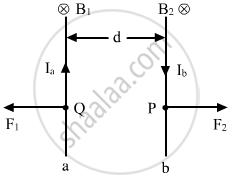
Now, let the direction of current in conductor b be reversed. The magnetic field B2 at point P due to current Ia flowing through a will be downwards. Similarly, the magnetic field B1 at point Q due to current Ib passing through b will also be downwards as shown. The force on a will be, therefore, towards the left. Also, the force on b will be towards the right. Hence, the two conductors will repel each other as shown.
संबंधित प्रश्न
If an electric field \[\vec{E}\] is also applied such that the particle continues moving along the original straight line path, what should be the magnitude and direction of the electric field \[\vec{E}\] ?
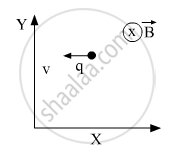
Consider a long, straight wire of cross-sectional area A carrying a current i. Let there be n free electrons per unit volume. An observer places himself on a trolley moving in the direction opposite to the current with a speed \[v = \frac{i}{\text{nAe}}\] and separation from the wire by a distance r. The magnetic field seen by the observer is very nearly
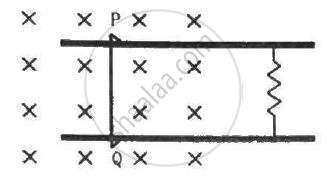
Consider the situation shown in figure. The wire PQ has mass m, resistance r and can slide on the smooth, horizontal parallel rails separated by a distance l. The resistance of the rails is negligible. A uniform magnetic field B exists in the rectangular region and a resistance R connects the rails outside the field region. At t = 0, the wire PQ is pushed towards right with a speed v0. Find (a) the current in the loop at an instant when the speed of the wire PQ is v, (b) the acceleration of the wire at this instant, (c) the velocity vas a functions of x and (d) the maximum distance the wire will move.
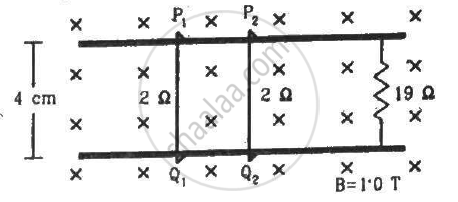
Consider the situation shown in figure. The wires P1Q1 and P2Q2 are made to slide on the rails with the same speed 5 cm s−1. Suppose the 19 Ω resistor is disconnected. Find the current through P2Q2 if (a) both the wires move towards right and (b) if P1Q1 moves towards left but P2Q2 moves towards right.
A deuteron and an alpha particle having equal kinetic energy enter perpendicular into a magnetic field. Let `r_d` and `r_alpha` be their respective radii of the circular path. The value of `(r_d)/(r_alpha)` is equal to ______.
A beam of protons with speed 4 × 10⁵ ms-1 enters a uniform magnetic field of 0.3 T at an angle of 60° to the magnetic field. The pitch of the resulting helical path of protons is close to :
(Mass of the proton = 1.67 × 10⁻²⁷ kg, charge of the proton = 1.69 × 10⁻¹⁹ C)
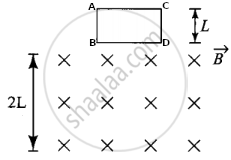
A square coil ABCD with its plane vertical is released from rest in a horizontal uniform magnetic field `vec"B"` of length 2L. The acceleration of the coil is ______.
A charged particle of charge q and mass m is projected in a region that contains an electric and magnetic field as shown in the figure with velocity V at an angle of 45° with x-direction. If V = `sqrt((qE)/m)`, then net deviation in particle motion will be (neglect the effect of gravity) in a clockwise direction approx ______ °.

Why does a magnetic force change only the direction of a charged particle's motion and not its speed?
An electron (mass \[9 \times 10^{-31}\] kg, charge \[1.6 \times 10^{-19}\] C) moves at \[3 \times 10^7\] m/s in a magnetic field of \[6 \times 10^{-4}\] T perpendicular to its velocity. The radius of its circular path is:
