Advertisements
Advertisements
प्रश्न
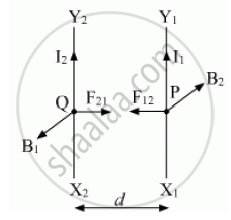
Two long straight parallel conductors carrying steady currents I1 and I2 are separated by a distance 'd'. Explain briefly, with the help of a suitable diagram, how the magnetic field due to one conductor acts on the other. Hence deduce the expression for the force acting between the two conductors. Mention the nature of this force.
Advertisements
उत्तर
Assumption: Current flows in the same direction.
Using Right hand thumb rule, the direction of the magnetic field at point P due to current I2 is perpendicular to the plane of paper and inwards.
Similarly, at point Q on X2Y2, the direction of magnetic field due to current I1 is perpendicularly outward.
Using Fleming’s left hand rule we can find the direction of forces F12 and F21 which are in opposite directions thus,
By Ampere’s circuited law, we have,
`B^2 =mu_0/(4pi) (2I_2)/d`
Now, F12 = I1LB2 (Where L ≡ length of the conductors)
`F_12 =(mu_0)/(4pi) (2I_1I_2L)/d =mu_0/(2pi)(I_1I_2L)/d`
In similar manner we get,
`F_21 =mu_0/(2pi) (I_1I_2L)/d .... (1)`
From above we get the magnitude of forces F12 and F21 are equal but in opposite direction. So,
F12 = −F21
Therefore, two parallel straight conductors carrying current in the same direction attract each other.
Similarly, we can prove if two parallel straight conductors carry currents in opposite direction, they repel each other with the same magnitude as equation (1).
संबंधित प्रश्न
Sketch a schematic diagram depicting oscillating electric and magnetic fields of an em wave propagating along + z-direction ?
The motion of copper plate is damped when it is allowed to oscillate between the two poles of a magnet. What is the cause of this damping?
A charged particle moving in a magnetic field experiences a resultant force ______
A circular coil of radius 10 cm is placed in a uniform magnetic field of 3.0 × 10⁻⁵ T with its plane perpendicular to the field initially. It is rotated at constant angular speed about an axis along the diameter of coil and perpendicular to magnetic field so that it undergoes half of rotation in 0.2 s. The maximum value of EMF induced (in µV) in the coil will be close to the integer ______.
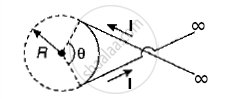
A wire carrying current i has the configuration shown in figure. For the magnetic field to be zero at the centre of the circle, θ must be:
A charged particle is accelerated through a potential difference of 12 kV and acquires a speed of 106 ms-1. It is projected perpendicularly into the magnetic field of strength 0.2 T. The radius of the circle described is ______ cm.
In uniform circular motion of a charged particle in a magnetic field, the magnetic force \[F = qvB\] acts as which of the following?
A charged particle's velocity makes an angle θ with a magnetic field \[\vec B\], where 0° < θ < 90°. The perpendicular component of velocity \[v_\perp = v \sin\theta\] is responsible for:
For a charged particle moving at an angle θ to a magnetic field \[\vec B\] (0° < θ < 90°), the parallel component of velocity \[v_\parallel = v \cos\theta\]:
The pitch of the helix described by a charged particle in a magnetic field is given by:
