Advertisements
Advertisements
Question
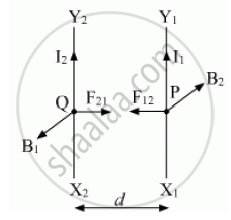
Two long straight parallel conductors carrying steady currents I1 and I2 are separated by a distance 'd'. Explain briefly, with the help of a suitable diagram, how the magnetic field due to one conductor acts on the other. Hence deduce the expression for the force acting between the two conductors. Mention the nature of this force.
Advertisements
Solution
Assumption: Current flows in the same direction.
Using Right hand thumb rule, the direction of the magnetic field at point P due to current I2 is perpendicular to the plane of paper and inwards.
Similarly, at point Q on X2Y2, the direction of magnetic field due to current I1 is perpendicularly outward.
Using Fleming’s left hand rule we can find the direction of forces F12 and F21 which are in opposite directions thus,
By Ampere’s circuited law, we have,
`B^2 =mu_0/(4pi) (2I_2)/d`
Now, F12 = I1LB2 (Where L ≡ length of the conductors)
`F_12 =(mu_0)/(4pi) (2I_1I_2L)/d =mu_0/(2pi)(I_1I_2L)/d`
In similar manner we get,
`F_21 =mu_0/(2pi) (I_1I_2L)/d .... (1)`
From above we get the magnitude of forces F12 and F21 are equal but in opposite direction. So,
F12 = −F21
Therefore, two parallel straight conductors carrying current in the same direction attract each other.
Similarly, we can prove if two parallel straight conductors carry currents in opposite direction, they repel each other with the same magnitude as equation (1).
RELATED QUESTIONS
Two identical coils P and Q each of radius R are lying in perpendicular planes such that they have a common centre. Find the magnitude and direction of the magnetic field at the common centre of the two coils, if they carry currents equal to I and \[\sqrt{3}\] I respectively.

Show with the help of a diagram how the force between the two conductors would change when the currents in them flow in the opposite directions?
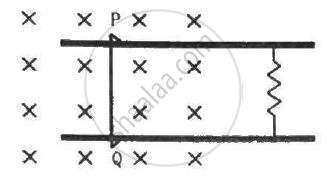
Consider the situation shown in figure. The wire PQ has mass m, resistance r and can slide on the smooth, horizontal parallel rails separated by a distance l. The resistance of the rails is negligible. A uniform magnetic field B exists in the rectangular region and a resistance R connects the rails outside the field region. At t = 0, the wire PQ is pushed towards right with a speed v0. Find (a) the current in the loop at an instant when the speed of the wire PQ is v, (b) the acceleration of the wire at this instant, (c) the velocity vas a functions of x and (d) the maximum distance the wire will move.
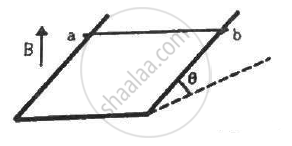
A wire ab of length l, mass m and resistance R slides on a smooth, thick pair of metallic rails joined at the bottom as shown in figure. The plane of the rails makes an angle θ with the horizontal. A vertical magnetic field B exists in the region. If the wire slides on the rails at a constant speed v, show that \[B = \sqrt{\frac{mg R sin\theta}{v l^2 \cos^2 \theta}}\]
If an electron is moving with velocity `vecnu` produces a magnetic field `vec"B"`, then ______.
Assertion(A): A proton and an electron, with same momenta, enter in a magnetic field in a direction at right angles to the lines of the force. The radius of the paths followed by them will be same.
Reason (R): Electron has less mass than the proton.
Select the most appropriate answer from the options given below:
A circular coil of radius 10 cm is placed in a uniform magnetic field of 3.0 × 10⁻⁵ T with its plane perpendicular to the field initially. It is rotated at constant angular speed about an axis along the diameter of coil and perpendicular to magnetic field so that it undergoes half of rotation in 0.2 s. The maximum value of EMF induced (in µV) in the coil will be close to the integer ______.
Which of the following statements about the magnetic force and electric force is TRUE regarding energy transfer to a charged particle?
The pitch of the helix described by a charged particle in a magnetic field is given by:
An electron (mass \[9 \times 10^{-31}\] kg, charge \[1.6 \times 10^{-19}\] C) moves at \[3 \times 10^7\] m/s in a magnetic field of \[6 \times 10^{-4}\] T perpendicular to its velocity. The radius of its circular path is:
