Advertisements
Advertisements
प्रश्न
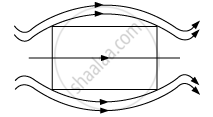
Depict the behaviour of magnetic field lines in the presence of a diamagnetic material?
Advertisements
उत्तर
When a diamagnetic material is placed in an external magnetic field, the field lines are repelled or expelled. They are represented as follows:
APPEARS IN
संबंधित प्रश्न
Sketch a schematic diagram depicting oscillating electric and magnetic fields of an em wave propagating along + z-direction ?
A moving charge produces
Consider a long, straight wire of cross-sectional area A carrying a current i. Let there be n free electrons per unit volume. An observer places himself on a trolley moving in the direction opposite to the current with a speed \[v = \frac{i}{\text{nAe}}\] and separation from the wire by a distance r. The magnetic field seen by the observer is very nearly
Assertion(A): A proton and an electron, with same momenta, enter in a magnetic field in a direction at right angles to the lines of the force. The radius of the paths followed by them will be same.
Reason (R): Electron has less mass than the proton.
Select the most appropriate answer from the options given below:
A deuteron and an alpha particle having equal kinetic energy enter perpendicular into a magnetic field. Let `r_d` and `r_alpha` be their respective radii of the circular path. The value of `(r_d)/(r_alpha)` is equal to ______.
The work done by the magnetic force on a moving charged particle is:
In uniform circular motion of a charged particle in a magnetic field, the magnetic force \[F = qvB\] acts as which of the following?
The frequency of revolution of a charged particle moving in a circular path in a magnetic field is:
The pitch of the helix described by a charged particle in a magnetic field is given by:
