Advertisements
Advertisements
प्रश्न
A moving charge produces
विकल्प
electric field only
magnetic field only
both of them
both of them
Advertisements
उत्तर
both of them
Because of the presence of a charge, a particle produces an electric field. Also, because of its motion, that is, the flow of charge or current, there is generation of a magnetic field.
APPEARS IN
संबंधित प्रश्न
Find the condition under which the charged particles moving with different speeds in the presence of electric and magnetic field vectors can be used to select charged particles of a particular speed.
Sketch a schematic diagram depicting oscillating electric and magnetic fields of an em wave propagating along + z-direction ?
Two proton beams going in the same direction repel each other whereas two wires carrying currents in the same direction attract each other. Explain.
Consider a long, straight wire of cross-sectional area A carrying a current i. Let there be n free electrons per unit volume. An observer places himself on a trolley moving in the direction opposite to the current with a speed \[v = \frac{i}{\text{nAe}}\] and separation from the wire by a distance r. The magnetic field seen by the observer is very nearly
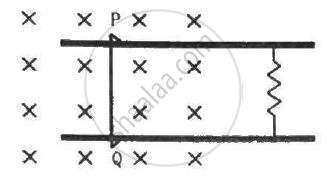
Consider the situation shown in figure. The wire PQ has mass m, resistance r and can slide on the smooth, horizontal parallel rails separated by a distance l. The resistance of the rails is negligible. A uniform magnetic field B exists in the rectangular region and a resistance R connects the rails outside the field region. At t = 0, the wire PQ is pushed towards right with a speed v0. Find (a) the current in the loop at an instant when the speed of the wire PQ is v, (b) the acceleration of the wire at this instant, (c) the velocity vas a functions of x and (d) the maximum distance the wire will move.
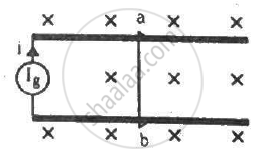
The current generator Ig' shown in figure, sends a constant current i through the circuit. The wire ab has a length l and mass m and can slide on the smooth, horizontal rails connected to Ig. The entire system lies in a vertical magnetic field B. Find the velocity of the wire as a function of time.
A magnetic field that varies in magnitude from point to point but has a constant direction (east to west) is set up in a chamber. A charged particle enters the chamber and travels undeflected along a straight path with constant speed. What can you say about the initial velocity of the particle?
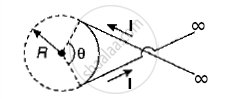
A wire carrying current i has the configuration shown in figure. For the magnetic field to be zero at the centre of the circle, θ must be:
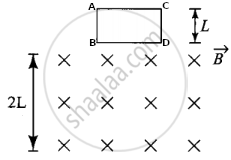
A square coil ABCD with its plane vertical is released from rest in a horizontal uniform magnetic field `vec"B"` of length 2L. The acceleration of the coil is ______.
A charged particle is accelerated through a potential difference of 12 kV and acquires a speed of 106 ms-1. It is projected perpendicularly into the magnetic field of strength 0.2 T. The radius of the circle described is ______ cm.
A charged particle of charge q and mass m is projected in a region that contains an electric and magnetic field as shown in the figure with velocity V at an angle of 45° with x-direction. If V = `sqrt((qE)/m)`, then net deviation in particle motion will be (neglect the effect of gravity) in a clockwise direction approx ______ °.

An electron (mass 9 × 10⁻³¹ kg and charge 1.6 × 10⁻¹⁹ C) moving with speed c/100 (c = speed of light)is injected into a magnetic field `vecB` of magnitude 9 × 10⁻⁴ T perpendicular to its direction of motion. We wish to apply an uniform electric field `vecE` together with the magnetic field so that the electron does not deflect from its path. Then (speed of light c = 3 × 10⁸ m s−1).
In uniform circular motion of a charged particle in a magnetic field, the magnetic force \[F = qvB\] acts as which of the following?
Which property of the cyclotron motion of a charged particle in a magnetic field forms the basis of particle accelerators?
A charged particle's velocity makes an angle θ with a magnetic field \[\vec B\], where 0° < θ < 90°. The perpendicular component of velocity \[v_\perp = v \sin\theta\] is responsible for:
An electron (mass \[9 \times 10^{-31}\] kg, charge \[1.6 \times 10^{-19}\] C) moves at \[3 \times 10^7\] m/s in a magnetic field of \[6 \times 10^{-4}\] T perpendicular to its velocity. The radius of its circular path is:
An electron moves at \[3 \times 10^7\] m/s in a circular path of radius 0.28 m in a magnetic field. Its frequency of revolution is approximately:
