Advertisements
Advertisements
Question
A moving charge produces
Options
electric field only
magnetic field only
both of them
both of them
Advertisements
Solution
both of them
Because of the presence of a charge, a particle produces an electric field. Also, because of its motion, that is, the flow of charge or current, there is generation of a magnetic field.
APPEARS IN
RELATED QUESTIONS
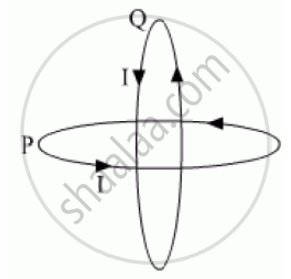
Two identical circular wires P and Q each of radius R and carrying current ‘I’ are kept in perpendicular planes such that they have a common centre as shown in the figure. Find the magnitude and direction of the net magnetic field at the common centre of the two coils.
Two proton beams going in the same direction repel each other whereas two wires carrying currents in the same direction attract each other. Explain.
Consider a long, straight wire of cross-sectional area A carrying a current i. Let there be n free electrons per unit volume. An observer places himself on a trolley moving in the direction opposite to the current with a speed \[v = \frac{i}{\text{nAe}}\] and separation from the wire by a distance r. The magnetic field seen by the observer is very nearly
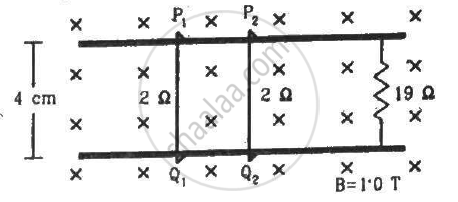
Consider the situation shown in figure. The wires P1Q1 and P2Q2 are made to slide on the rails with the same speed 5 cm s−1. Suppose the 19 Ω resistor is disconnected. Find the current through P2Q2 if (a) both the wires move towards right and (b) if P1Q1 moves towards left but P2Q2 moves towards right.
If an electron is moving with velocity `vecnu` produces a magnetic field `vec"B"`, then ______.
A circular coil of radius 10 cm is placed in a uniform magnetic field of 3.0 × 10⁻⁵ T with its plane perpendicular to the field initially. It is rotated at constant angular speed about an axis along the diameter of coil and perpendicular to magnetic field so that it undergoes half of rotation in 0.2 s. The maximum value of EMF induced (in µV) in the coil will be close to the integer ______.
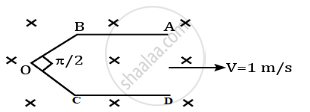
A conductor ABOCD moves along its bisector with a velocity 1 m/s through a perpendicular magnetic field of 1 wb/m2, as shown in figure. If all the four sides are 1 m length each, then the induced emf between A and Din approx is ______V.
An α particle is moving along a circle of radius R with a constant angular velocity ω. Point A lies in the same plane at a distance 2R from the centre. Point A records magnetic field produced by α particle, if the minimum time interval between two successive times at which A records zero magnetic field is 't' the angular speed ω, in terms of t is ______.
Protons and singly ionized atoms of U235 and U238 are passed in turn (which means one after the other and not at the same time) through a velocity selector and then enter a uniform magnetic field. The protons describe semicircles of radius 10 mm. The separation between the ions of U235 and U238 after describing the semicircle is given by ______.
A charged particle of charge q and mass m is projected in a region that contains an electric and magnetic field as shown in the figure with velocity V at an angle of 45° with x-direction. If V = `sqrt((qE)/m)`, then net deviation in particle motion will be (neglect the effect of gravity) in a clockwise direction approx ______ °.

Why does a magnetic force change only the direction of a charged particle's motion and not its speed?
Which of the following statements about the magnetic force and electric force is TRUE regarding energy transfer to a charged particle?
A charged particle enters a magnetic field \[\vec B\] with velocity \[\vec v\] such that the angle between them is 90°. What type of path does the particle follow?
In uniform circular motion of a charged particle in a magnetic field, the magnetic force \[F = qvB\] acts as which of the following?
The frequency of revolution of a charged particle moving in a circular path in a magnetic field is:
An electron (mass \[9 \times 10^{-31}\] kg, charge \[1.6 \times 10^{-19}\] C) moves at \[3 \times 10^7\] m/s in a magnetic field of \[6 \times 10^{-4}\] T perpendicular to its velocity. The radius of its circular path is:
