Advertisements
Advertisements
प्रश्न
Find the condition under which the charged particles moving with different speeds in the presence of electric and magnetic field vectors can be used to select charged particles of a particular speed.
Advertisements
उत्तर
Force in the presence of magnetic and electric field is given as
`vecF=q(vecE+vecv xx vecB)`
Consider that the electric and the magnetic field are perpendicular to each other and, also, perpendicular to the velocity of the particle.
`vecE=Ehatj,vecB=Bhatk,vecB,vecv=vhati`
Then we have :`vec(F_E)=qvecE=qEhatj, vec(F_B)=q vecv xx vecB, =q(vhatixxBhatk)=-qBhatj`
`therefore vecF=q(E-vB)hatj`
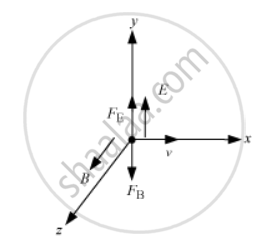
If we adjust the values of `vecE` and `vecB` such that magnitudes of the two forces are equal, then the total force on the charge will be zero and it will move in the fields undeflected. This happens when
qE = qvB
`therefore v=E/B`
The above condition can be used to select a charged particle of particular velocity from the charges moving with different speeds. Therefore, it is called velocity selector.
संबंधित प्रश्न
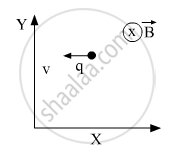
If an electric field \[\vec{E}\] is also applied such that the particle continues moving along the original straight line path, what should be the magnitude and direction of the electric field \[\vec{E}\] ?
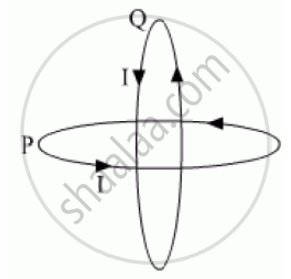
Two identical circular wires P and Q each of radius R and carrying current ‘I’ are kept in perpendicular planes such that they have a common centre as shown in the figure. Find the magnitude and direction of the net magnetic field at the common centre of the two coils.
Two proton beams going in the same direction repel each other whereas two wires carrying currents in the same direction attract each other. Explain.
A moving charge produces
A moving charge will gain kinetic energy due to the application of ______.
A charged particle moving in a magnetic field experiences a resultant force ______
A charged particle of charge q and mass m is projected in a region that contains an electric and magnetic field as shown in the figure with velocity V at an angle of 45° with x-direction. If V = `sqrt((qE)/m)`, then net deviation in particle motion will be (neglect the effect of gravity) in a clockwise direction approx ______ °.

The work done by the magnetic force on a moving charged particle is:
For a charged particle moving at an angle θ to a magnetic field \[\vec B\] (0° < θ < 90°), the parallel component of velocity \[v_\parallel = v \cos\theta\]:
An electron (mass \[9 \times 10^{-31}\] kg, charge \[1.6 \times 10^{-19}\] C) moves at \[3 \times 10^7\] m/s in a magnetic field of \[6 \times 10^{-4}\] T perpendicular to its velocity. The radius of its circular path is:
