Advertisements
Advertisements
Question
Find the condition under which the charged particles moving with different speeds in the presence of electric and magnetic field vectors can be used to select charged particles of a particular speed.
Advertisements
Solution
Force in the presence of magnetic and electric field is given as
`vecF=q(vecE+vecv xx vecB)`
Consider that the electric and the magnetic field are perpendicular to each other and, also, perpendicular to the velocity of the particle.
`vecE=Ehatj,vecB=Bhatk,vecB,vecv=vhati`
Then we have :`vec(F_E)=qvecE=qEhatj, vec(F_B)=q vecv xx vecB, =q(vhatixxBhatk)=-qBhatj`
`therefore vecF=q(E-vB)hatj`
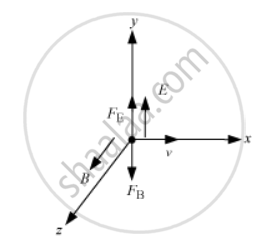
If we adjust the values of `vecE` and `vecB` such that magnitudes of the two forces are equal, then the total force on the charge will be zero and it will move in the fields undeflected. This happens when
qE = qvB
`therefore v=E/B`
The above condition can be used to select a charged particle of particular velocity from the charges moving with different speeds. Therefore, it is called velocity selector.
RELATED QUESTIONS
Depict the behaviour of magnetic field lines in the presence of a diamagnetic material?
Two identical coils P and Q each of radius R are lying in perpendicular planes such that they have a common centre. Find the magnitude and direction of the magnetic field at the common centre of the two coils, if they carry currents equal to I and \[\sqrt{3}\] I respectively.

Sketch a schematic diagram depicting oscillating electric and magnetic fields of an em wave propagating along + z-direction ?
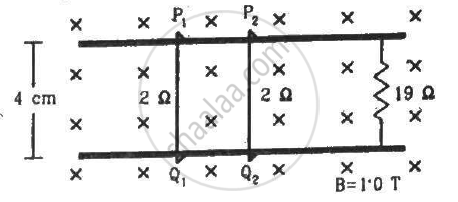
Consider the situation shown in figure. The wires P1Q1 and P2Q2 are made to slide on the rails with the same speed 5 cm s−1. Suppose the 19 Ω resistor is disconnected. Find the current through P2Q2 if (a) both the wires move towards right and (b) if P1Q1 moves towards left but P2Q2 moves towards right.
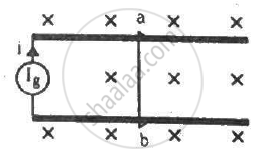
The current generator Ig' shown in figure, sends a constant current i through the circuit. The wire ab has a length l and mass m and can slide on the smooth, horizontal rails connected to Ig. The entire system lies in a vertical magnetic field B. Find the velocity of the wire as a function of time.
A charged particle moves through a magnetic field perpendicular to its direction. Then ______.
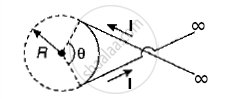
A wire carrying current i has the configuration shown in figure. For the magnetic field to be zero at the centre of the circle, θ must be:
The work done by the magnetic force on a moving charged particle is:
Which property of the cyclotron motion of a charged particle in a magnetic field forms the basis of particle accelerators?
For a charged particle moving at an angle θ to a magnetic field \[\vec B\] (0° < θ < 90°), the parallel component of velocity \[v_\parallel = v \cos\theta\]:
