Advertisements
Advertisements
Question
A 12.5 eV electron beam is used to bombard gaseous hydrogen at room temperature. What series of wavelengths will be emitted?
Advertisements
Solution
It is given that the energy of the electron beam used to bombard gaseous hydrogen at room temperature is 12.5 eV. Also, the energy of the gaseous hydrogen in its ground state at room temperature is −13.6 eV.
When gaseous hydrogen is bombarded with an electron beam, the energy of the gaseous hydrogen becomes −13.6 + 12.5 eV i.e., −1.1 eV.
Orbital energy is related to orbit level (n) as:
E = `(-13.6)/(n)^2 ev`
For n = 3, E = `(-13.6)/9` = −1.5 eV
This energy is approximately equal to the energy of gaseous hydrogen. It can be concluded that the electron has jumped from n = 1 to n = 3 level.
During its de-excitation, the electrons can jump from n = 3 to n = 1 directly, which forms a line of the Lyman series of the hydrogen spectrum.
We have the relation for wave number for the Lyman series as:
`1/lambda = R_y (1/1^2 - 1/n^2)`
Where
Ry = Rydberg constant = 1.097 × 10⁷ m−1
λ = Wavelength of radiation emitted by the transition of the electron
For n = 3, we can obtain λ as:
`1/lambda = 1.0997 xx 10^7 (1/1^2 - 1/3^2)`
= `1.097 xx 10^7 (1 - 1/9)`
= `1.097 xx 10^7 xx 8/9`
`lambda = 9/(8 xx 1.097 xx 10^7)`
= 102.55 nm
If the electron jumps from n = 2 to n = 1, then the wavelength of the radiation is given as:
`1/lambda = 1.097 xx 10^7 (1/1^2 - 1/2^2)`
= `1.097 xx 10^7(1- 1/4)`
= `1.097 xx 10^7 xx 3/4`
`lambda = 4/(1.097 xx 10^7 xx 3)`
= 121.54 nm
If the transition takes place from n = 3 to n = 2, then the wavelength of the radiation is given as:
`1/lambda = 1.097 xx 10^7 (1/2^2 - 1/3^2)`
`= 1.097 xx 10^7 (1/4 - 1/9)`
= `1.097 xx 10^7 xx 5/36`
= `36 /(5xx1.097 xx 10^7)`
= 656.33 nm
This radiation corresponds to the Balmer series of the hydrogen spectrum.
Hence, in the Lyman series, two wavelengths, i.e., 102.55 nm and 121.54 nm, are emitted. And in the Balmer series, one wavelength, i.e., 656.33 nm, is emitted.
APPEARS IN
RELATED QUESTIONS
The first excited energy of a He+ ion is the same as the ground state energy of hydrogen. Is it always true that one of the energies of any hydrogen-like ion will be the same as the ground state energy of a hydrogen atom?
Which wavelengths will be emitted by a sample of atomic hydrogen gas (in ground state) if electrons of energy 12.2 eV collide with the atoms of the gas?
When white radiation is passed through a sample of hydrogen gas at room temperature, absorption lines are observed in Lyman series only. Explain.
The minimum orbital angular momentum of the electron in a hydrogen atom is
Which of the following curves may represent the speed of the electron in a hydrogen atom as a function of trincipal quantum number n?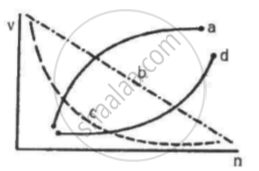
Ionization energy of a hydrogen-like ion A is greater than that of another hydrogen-like ion B. Let r, u, E and L represent the radius of the orbit, speed of the electron, energy of the atom and orbital angular momentum of the electron respectively. In ground state
A group of hydrogen atoms are prepared in n = 4 states. List the wavelength that are emitted as the atoms make transitions and return to n = 2 states.
Whenever a photon is emitted by hydrogen in Balmer series, it is followed by another photon in Lyman series. What wavelength does this latter photon correspond to?
What is the energy of a hydrogen atom in the first excited state if the potential energy is taken to be zero in the ground state?
Find the maximum angular speed of the electron of a hydrogen atom in a stationary orbit.
Suppose, in certain conditions only those transitions are allowed to hydrogen atoms in which the principal quantum number n changes by 2. (a) Find the smallest wavelength emitted by hydrogen. (b) List the wavelength emitted by hydrogen in the visible range (380 nm to 780 nm).
Find the temperature at which the average thermal kinetic energy is equal to the energy needed to take a hydrogen atom from its ground state to n = 3 state. Hydrogen can now emit red light of wavelength 653.1 nm. Because of Maxwellian distribution of speeds, a hydrogen sample emits red light at temperatures much lower than that obtained from this problem. Assume that hydrogen molecules dissociate into atoms.
A hydrogen atom in ground state absorbs a photon of ultraviolet radiation of wavelength 50 nm. Assuming that the entire photon energy is taken up by the electron with what kinetic energy will the electron be ejected?
When a photon is emitted from an atom, the atom recoils. The kinetic energy of recoil and the energy of the photon come from the difference in energies between the states involved in the transition. Suppose, a hydrogen atom changes its state from n = 3 to n = 2. Calculate the fractional change in the wavelength of light emitted, due to the recoil.
Positronium is just like a H-atom with the proton replaced by the positively charged anti-particle of the electron (called the positron which is as massive as the electron). What would be the ground state energy of positronium?
Which mathematical relation represents the energy of a photon emitted during an electronic transition from state ni to state nf?
Why do only discrete frequencies appear in atomic emission spectra?
In what year was Niels Bohr awarded the Nobel Prize in Physics for his explanation of the hydrogen atom spectrum?
When an electron in a rarefied gas atom absorbs a photon, from which energy state to which energy state does the electron transition?
