Advertisements
Advertisements
Question
An electron with kinetic energy 5 eV is incident on a hydrogen atom in its ground state. The collision
Options
must be elastic
may be partially elastic
must be completely inelastic
may be completely inelastic
Advertisements
Solution
must be elastic.
The minimum energy required to excite a hydrogen atom from its ground state to 1st excited state is approximately 10 eV. As the incident electron energy is not sufficient for excitation of the hydrogen atom so electron will not get absorbed in the hydrogen atom so it can not be an inelastic collision. Also this collision can not be partially elastic because in an partially elestic collision, there is a net loss on kinetic energy. If the energy is lost then corresponding amount of heat shlould have been produced but it is not so which implies that the collision is completely elastic.
APPEARS IN
RELATED QUESTIONS
Find the wavelength of the electron orbiting in the first excited state in hydrogen atom.
The minimum orbital angular momentum of the electron in a hydrogen atom is
Which of the following curves may represent the speed of the electron in a hydrogen atom as a function of trincipal quantum number n?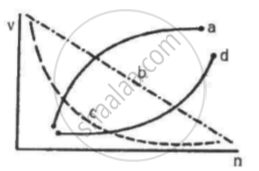
Let An be the area enclosed by the nth orbit in a hydrogen atom. The graph of ln (An/A1) against ln(n)
(a) will pass through the origin
(b) will be a straight line with slope 4
(c) will be a monotonically increasing nonlinear curve
(d) will be a circle
Calculate the smallest wavelength of radiation that may be emitted by (a) hydrogen, (b) He+ and (c) Li++.
Find the binding energy of a hydrogen atom in the state n = 2.
(a) Find the first excitation potential of He+ ion. (b) Find the ionization potential of Li++ion.
A hydrogen atom in a state having a binding energy of 0.85 eV makes transition to a state with excitation energy 10.2 e.V (a) Identify the quantum numbers n of the upper and the lower energy states involved in the transition. (b) Find the wavelength of the emitted radiation.
Find the maximum angular speed of the electron of a hydrogen atom in a stationary orbit.
A hydrogen atom in ground state absorbs a photon of ultraviolet radiation of wavelength 50 nm. Assuming that the entire photon energy is taken up by the electron with what kinetic energy will the electron be ejected?
A hydrogen atom moving at speed υ collides with another hydrogen atom kept at rest. Find the minimum value of υ for which one of the atoms may get ionized.
The mass of a hydrogen atom = 1.67 × 10⁻²⁷ kg.
When a photon is emitted from an atom, the atom recoils. The kinetic energy of recoil and the energy of the photon come from the difference in energies between the states involved in the transition. Suppose, a hydrogen atom changes its state from n = 3 to n = 2. Calculate the fractional change in the wavelength of light emitted, due to the recoil.
Consider an excited hydrogen atom in state n moving with a velocity υ(ν<<c). It emits a photon in the direction of its motion and changes its state to a lower state m. Apply momentum and energy conservation principles to calculate the frequency ν of the emitted radiation. Compare this with the frequency ν0 emitted if the atom were at rest.
The Balmer series for the H-atom can be observed ______.
- if we measure the frequencies of light emitted when an excited atom falls to the ground state.
- if we measure the frequencies of light emitted due to transitions between excited states and the first excited state.
- in any transition in a H-atom.
- as a sequence of frequencies with the higher frequencies getting closely packed.
Positronium is just like a H-atom with the proton replaced by the positively charged anti-particle of the electron (called the positron which is as massive as the electron). What would be the ground state energy of positronium?
A hydrogen atom makes a transition from n = 5 to n = 1 orbit. The wavelength of photon emitted is λ. The wavelength of photon emitted when it makes a transition from n = 5 to n = 2 orbit is ______.
Why do only discrete frequencies appear in atomic emission spectra?
What is the physical significance of Planck's constant (h) in the equation \[h\nu_{if} = E_{ni} - E_{nf}\]?
