Advertisements
Advertisements
Question
What will be the energy corresponding to the first excited state of a hydrogen atom if the potential energy of the atom is taken to be 10 eV when the electron is widely separated from the proton? Can we still write En = E1/n2, or rn = a0 n2?
Advertisements
Solution
Energy of nth state of hydrogen is given by
`E_n = -13.6/n^2 eV`
Energy of first excited state (n = 2) of hydrogen, `E_1 = -13.6/4 eV = 3.4 eV`
This relation holds true when the refrence point energy is zero.Usually the refrence point energy is the energy of the atom when the electron is widely separated from the proton.In the given question, the potential energy of the atom is taken to be 10 eV when the electron is widely separated from the proton so here our refrence point energy is 10 eV. Earlier The energy of first excited state was -3.4 eV when the refrence point had zero energy but now as the refrence point has shifted so The energy of the first excited state will also shift by the corresponding amount.Thus,
E1, = -3.4 eV-10 eV = -13.4 eV
We still write En = E1/n2, or rn = a0 n2 because these formulas are independent of the refrence point enegy.
APPEARS IN
RELATED QUESTIONS
If Bohr’s quantisation postulate (angular momentum = nh/2π) is a basic law of nature, it should be equally valid for the case of planetary motion also. Why then do we never speak of quantisation of orbits of planets around the sun?
The first excited energy of a He+ ion is the same as the ground state energy of hydrogen. Is it always true that one of the energies of any hydrogen-like ion will be the same as the ground state energy of a hydrogen atom?
Which wavelengths will be emitted by a sample of atomic hydrogen gas (in ground state) if electrons of energy 12.2 eV collide with the atoms of the gas?
The minimum orbital angular momentum of the electron in a hydrogen atom is
In which of the following transitions will the wavelength be minimum?
Which of the following curves may represent the speed of the electron in a hydrogen atom as a function of trincipal quantum number n?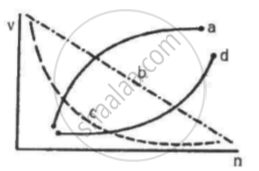
The radius of the shortest orbit in a one-electron system is 18 pm. It may be
A hydrogen atom in ground state absorbs 10.2 eV of energy. The orbital angular momentum of the electron is increased by
An electron with kinetic energy 5 eV is incident on a hydrogen atom in its ground state. The collision
Let An be the area enclosed by the nth orbit in a hydrogen atom. The graph of ln (An/A1) against ln(n)
(a) will pass through the origin
(b) will be a straight line with slope 4
(c) will be a monotonically increasing nonlinear curve
(d) will be a circle
A group of hydrogen atoms are prepared in n = 4 states. List the wavelength that are emitted as the atoms make transitions and return to n = 2 states.
A gas of hydrogen-like ions is prepared in a particular excited state A. It emits photons having wavelength equal to the wavelength of the first line of the Lyman series together with photons of five other wavelengths. Identify the gas and find the principal quantum number of the state A.
Electrons are emitted from an electron gun at almost zero velocity and are accelerated by an electric field E through a distance of 1.0 m. The electrons are now scattered by an atomic hydrogen sample in ground state. What should be the minimum value of E so that red light of wavelength 656.3 nm may be emitted by the hydrogen?
A hydrogen atom moving at speed υ collides with another hydrogen atom kept at rest. Find the minimum value of υ for which one of the atoms may get ionized.
The mass of a hydrogen atom = 1.67 × 10⁻²⁷ kg.
A hydrogen atom makes a transition from n = 5 to n = 1 orbit. The wavelength of photon emitted is λ. The wavelength of photon emitted when it makes a transition from n = 5 to n = 2 orbit is ______.
What is the process called when an atom absorbs a photon whose energy exactly matches the energy required for an electronic transition?
When an electron in a rarefied gas atom absorbs a photon, from which energy state to which energy state does the electron transition?
What is a key limitation of continuous spectra that is resolved by the observation of discrete emission lines?
