Advertisements
Advertisements
Question
A hydrogen atom in ground state absorbs a photon of ultraviolet radiation of wavelength 50 nm. Assuming that the entire photon energy is taken up by the electron with what kinetic energy will the electron be ejected?
Advertisements
Solution
Given:
Wavelength of ultraviolet radiation, `lamda = 50 nm = 50xx10^-9m`
We know that the work function of an atom is the energy required to remove an electron from the surface of the atom. So, we can find the work function by calculating the energy required to remove the electron from n1 = 1 to n2 = ∞.
Work function,
`W_0 = 13.6 (1/1 - 1/∞)`
= 13.6 eV
Using Einstein's photoelectric equation, we get
`E = W_0 +KE`
`rArr (hc)/(lamda) - 13.6 =KE (therefore E = (hc)/lamda)`
`rArr 1242/50 - 13.6 = KE`
`rArr KE = 24.84 - 13.6`
= 11.24 eV
APPEARS IN
RELATED QUESTIONS
If Bohr’s quantisation postulate (angular momentum = nh/2π) is a basic law of nature, it should be equally valid for the case of planetary motion also. Why then do we never speak of quantisation of orbits of planets around the sun?
When white radiation is passed through a sample of hydrogen gas at room temperature, absorption lines are observed in Lyman series only. Explain.
Which of the following curves may represent the speed of the electron in a hydrogen atom as a function of trincipal quantum number n?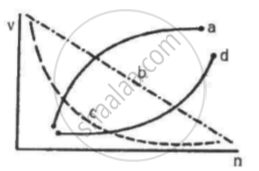
The radius of the shortest orbit in a one-electron system is 18 pm. It may be
A hydrogen atom in ground state absorbs 10.2 eV of energy. The orbital angular momentum of the electron is increased by
Which of the following products in a hydrogen atom are independent of the principal quantum number n? The symbols have their usual meanings.
(a) vn
(b) Er
(c) En
(d) vr
Ionization energy of a hydrogen-like ion A is greater than that of another hydrogen-like ion B. Let r, u, E and L represent the radius of the orbit, speed of the electron, energy of the atom and orbital angular momentum of the electron respectively. In ground state
Calculate the smallest wavelength of radiation that may be emitted by (a) hydrogen, (b) He+ and (c) Li++.
A hydrogen atom in a state having a binding energy of 0.85 eV makes transition to a state with excitation energy 10.2 e.V (a) Identify the quantum numbers n of the upper and the lower energy states involved in the transition. (b) Find the wavelength of the emitted radiation.
The average kinetic energy of molecules in a gas at temperature T is 1.5 kT. Find the temperature at which the average kinetic energy of the molecules of hydrogen equals the binding energy of its atoms. Will hydrogen remain in molecular from at this temperature? Take k = 8.62 × 10⁻⁵ eV K−1.
Average lifetime of a hydrogen atom excited to n = 2 state is 10−8 s. Find the number of revolutions made by the electron on the average before it jumps to the ground state.
Electrons are emitted from an electron gun at almost zero velocity and are accelerated by an electric field E through a distance of 1.0 m. The electrons are now scattered by an atomic hydrogen sample in ground state. What should be the minimum value of E so that red light of wavelength 656.3 nm may be emitted by the hydrogen?
A hydrogen atom moving at speed υ collides with another hydrogen atom kept at rest. Find the minimum value of υ for which one of the atoms may get ionized.
The mass of a hydrogen atom = 1.67 × 10⁻²⁷ kg.
When a photon is emitted from an atom, the atom recoils. The kinetic energy of recoil and the energy of the photon come from the difference in energies between the states involved in the transition. Suppose, a hydrogen atom changes its state from n = 3 to n = 2. Calculate the fractional change in the wavelength of light emitted, due to the recoil.
Positronium is just like a H-atom with the proton replaced by the positively charged anti-particle of the electron (called the positron which is as massive as the electron). What would be the ground state energy of positronium?
Why do only discrete frequencies appear in atomic emission spectra?
What are absorption lines in a continuous spectrum?
When an electron in a rarefied gas atom absorbs a photon, from which energy state to which energy state does the electron transition?
