Advertisements
Advertisements
Question
Which of the following curves may represent the speed of the electron in a hydrogen atom as a function of trincipal quantum number n?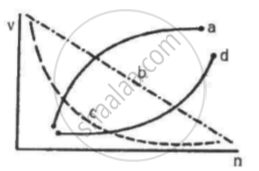
Advertisements
Solution
(c)
The speed (v) of electron can be expressed as
`v = (Ze^2)/(2∈_0hn)` ....(1)
Here,
Z = Number of protons in the nucleus
e = Magnitude of charge on electron charge
n = Principal quantum number
h = Planck's constant
It can be observed from equation (1) that the velocity of electron is inversely proportional to the principal quantum number (n).
Therefore, the graph between them must be a rectangular hyperbola.
The correct curve is (c).
APPEARS IN
RELATED QUESTIONS
A 12.5 eV electron beam is used to bombard gaseous hydrogen at room temperature. What series of wavelengths will be emitted?
The first excited energy of a He+ ion is the same as the ground state energy of hydrogen. Is it always true that one of the energies of any hydrogen-like ion will be the same as the ground state energy of a hydrogen atom?
Which wavelengths will be emitted by a sample of atomic hydrogen gas (in ground state) if electrons of energy 12.2 eV collide with the atoms of the gas?
What will be the energy corresponding to the first excited state of a hydrogen atom if the potential energy of the atom is taken to be 10 eV when the electron is widely separated from the proton? Can we still write En = E1/n2, or rn = a0 n2?
The minimum orbital angular momentum of the electron in a hydrogen atom is
Let An be the area enclosed by the nth orbit in a hydrogen atom. The graph of ln (An/A1) against ln(n)
(a) will pass through the origin
(b) will be a straight line with slope 4
(c) will be a monotonically increasing nonlinear curve
(d) will be a circle
Find the binding energy of a hydrogen atom in the state n = 2.
A hydrogen atom emits ultraviolet radiation of wavelength 102.5 nm. What are the quantum numbers of the states involved in the transition?
(a) Find the first excitation potential of He+ ion. (b) Find the ionization potential of Li++ion.
Find the maximum Coulomb force that can act on the electron due to the nucleus in a hydrogen atom.
Whenever a photon is emitted by hydrogen in Balmer series, it is followed by another photon in Lyman series. What wavelength does this latter photon correspond to?
What is the energy of a hydrogen atom in the first excited state if the potential energy is taken to be zero in the ground state?
The average kinetic energy of molecules in a gas at temperature T is 1.5 kT. Find the temperature at which the average kinetic energy of the molecules of hydrogen equals the binding energy of its atoms. Will hydrogen remain in molecular from at this temperature? Take k = 8.62 × 10⁻⁵ eV K−1.
Show that the ratio of the magnetic dipole moment to the angular momentum (l = mvr) is a universal constant for hydrogen-like atoms and ions. Find its value.
A hydrogen atom in ground state absorbs a photon of ultraviolet radiation of wavelength 50 nm. Assuming that the entire photon energy is taken up by the electron with what kinetic energy will the electron be ejected?
When a photon is emitted from an atom, the atom recoils. The kinetic energy of recoil and the energy of the photon come from the difference in energies between the states involved in the transition. Suppose, a hydrogen atom changes its state from n = 3 to n = 2. Calculate the fractional change in the wavelength of light emitted, due to the recoil.
Let En = `(-1)/(8ε_0^2) (me^4)/(n^2h^2)` be the energy of the nth level of H-atom. If all the H-atoms are in the ground state and radiation of frequency (E2 - E1)/h falls on it ______.
- it will not be absorbed at all.
- some of atoms will move to the first excited state.
- all atoms will be excited to the n = 2 state.
- no atoms will make a transition to the n = 3 state.
A hydrogen atom makes a transition from n = 5 to n = 1 orbit. The wavelength of photon emitted is λ. The wavelength of photon emitted when it makes a transition from n = 5 to n = 2 orbit is ______.
What is the process called when an atom absorbs a photon whose energy exactly matches the energy required for an electronic transition?
What is a key limitation of continuous spectra that is resolved by the observation of discrete emission lines?
