Advertisements
Advertisements
Question
In which of the following systems will the wavelength corresponding to n = 2 to n = 1 be minimum?
Options
Hydrogen atom
Deuterium atom
Singly ionized helium
Doubly ionized lithium
Advertisements
Solution
Doubly ionized lithium
The wavelength corresponding the transition from n2 to n1 is given by
`1/lamda =RZ^2 (1/n_1^2 - 1/n_2^2)`]
Here,
R = Rydberg constant
Z = Atomic number of the ion
From the given formula, it can be observed that the wavelength is inversely proportional to the square of the atomic number.
Therefore, the wavelength corresponding to n = 2 to n = 1 will be minimum in doubly ionized lithium ion because for lithium, Z = 3.
APPEARS IN
RELATED QUESTIONS
(i) State Bohr's quantization condition for defining stationary orbits. How does the de Broglie hypothesis explain the stationary orbits?
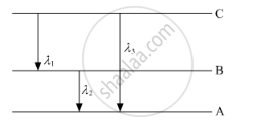
(ii) Find the relation between three wavelengths λ1, λ2 and λ3 from the energy-level diagram shown below.
Lifetimes of the molecules in the excited states are often measured by using pulsed radiation source of duration nearly in the nanosecond range. If the radiation source has a duration of 2 ns and the number of photons emitted during the pulse source is 2.5 × 10¹⁵, calculate the energy of the source.
- Using the Bohr’s model, calculate the speed of the electron in a hydrogen atom in the n = 1, 2 and 3 levels.
- Calculate the orbital period in each of these levels.
The difference in the frequencies of series limit of Lyman series and Balmer series is equal to the frequency of the first line of the Lyman series. Explain.
In a laser tube, all the photons
Calculate the magnetic dipole moment corresponding to the motion of the electron in the ground state of a hydrogen atom.
When the electron orbiting in hydrogen atom in its ground state moves to the third excited state, show how the de Broglie wavelength associated with it would be affected.
Use Bohr’s model of hydrogen atom to obtain the relationship between the angular momentum and the magnetic moment of the revolving electron.
In Bohr model of hydrogen atom, which of the following is quantised?
Using Bohr's postulates derive the expression for the radius of nth orbit of the electron.
The angular momentum of electron in nth orbit is given by
Taking the Bohr radius as a0 = 53 pm, the radius of Li++ ion in its ground state, on the basis of Bohr’s model, will be about ______.
When an electron falls from a higher energy to a lower energy level, the difference in the energies appears in the form of electromagnetic radiation. Why cannot it be emitted as other forms of energy?
Find the ratio of energies of photons produced due to transition of an election of hydrogen atom from its (i) second permitted energy level to the first level. and (ii) the highest permitted energy level to the first permitted level.
The electron in a hydrogen atom first jumps from the third excited state to the second excited state and subsequently to the first excited state. The ratio of the respective wavelengths, λ1/λ2, of the photons emitted in this process is ______.
If 13.6 eV energy is required to ionize the hydrogen atom, then the energy required to remove an electron from n = 2 is ______.
Specify the transition of an electron in the wavelength of the line in the Bohr model of the hydrogen atom which gives rise to the spectral line of the highest wavelength ______.
How much is the angular momentum of an electron when it is orbiting in the second Bohr orbit of hydrogen atom?
The figure below is the Energy level diagram for the Hydrogen atom. Study the transitions shown and answer the following question:
- State the type of spectrum obtained.
- Name the series of spectrum obtained.

On the basis of Bohr's theory, derive an expression for the radius of the nth orbit of an electron of hydrogen atom.
