Advertisements
Advertisements
Question
Find the wavelength of the radiation emitted by hydrogen in the transitions (a) n = 3 to n= 2, (b) n = 5 to n = 4 and (c) n = 10 to n = 9.
Advertisements
Solution
From Balmer empirical formula, the wavelength `(lamda)` of the radiation is given by
`1/lamda = R (1/(n_1^2) - 1/n_2^2)`
Here, R = Rydberg constant = `1.097 xx 10^7 m^-1`
n1 = Quantum number of final state
n2 = Quantum number of initial state
(a)
For transition from n = 3 to n = 2:
Here,
n1 = 2
n2 = 3
`1/lamda = 1.09737xx10^7xx (1/4 - 1/9)`
`rArr lamda = 36/(5xx1.0973xx10^7`
`= 6.56 xx 10^-7 = 656 nm`
(b)
For transition from n = 5 to n = 4:
Here,
n1 = 4
n2 = 5
`1/lamda = 1.09737 xx 10^-7 (1/16 - 1/25)`
`rArr = 400/(1.09737xx10^7xx9)`
= 4050 nm
(c)
For transition from n = 10 to n = 9:
Here,
n1 = 9
n2 = 10
`1/lamda = 1.09737 xx 10^7 (1/81 - 1/100)`
`lamda = (81xx100)/(19xx1.09737xx10^7)`
= 38849 nm
APPEARS IN
RELATED QUESTIONS
(i) State Bohr's quantization condition for defining stationary orbits. How does the de Broglie hypothesis explain the stationary orbits?
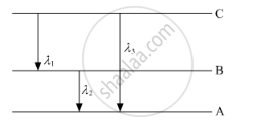
(ii) Find the relation between three wavelengths λ1, λ2 and λ3 from the energy-level diagram shown below.
What is the energy in joules, required to shift the electron of the hydrogen atom from the first Bohr orbit to the fifth Bohr orbit and what is the wavelength of the light emitted when the electron returns to the ground state? The ground state electron energy is –2.18 × 10⁻¹¹ ergs.
The longest wavelength doublet absorption transition is observed at 589 and 589.6 nm. Calculate the frequency of each transition and energy difference between two excited states.
If the photon of the wavelength 150 pm strikes an atom and one of its inner bound electrons is ejected out with a velocity of 1.5 × 10⁷ ms–1, calculate the energy with which it is bound to the nucleus.
On the basis of Bohr's theory, derive an expression for the radius of the nth orbit of an electron of the hydrogen atom.
Using Bohr’s postulates, obtain the expressions for (i) kinetic energy and (ii) potential energy of the electron in stationary state of hydrogen atom.
Draw the energy level diagram showing how the transitions between energy levels result in the appearance of Lymann Series.
When a photon stimulates the emission of another photon, the two photons have
(a) same energy
(b) same direction
(c) same phase
(d) same wavelength
Radiation coming from transition n = 2 to n = 1 of hydrogen atoms falls on helium ions in n = 1 and n = 2 states. What are the possible transitions of helium ions as they absorbs energy from the radiation?
The light emitted in the transition n = 3 to n = 2 in hydrogen is called Hα light. Find the maximum work function a metal can have so that Hα light can emit photoelectrons from it.
State any two Bohr’s postulates and write the energy value of the ground state of the hydrogen atom.
Answer the following question.
Calculate the orbital period of the electron in the first excited state of the hydrogen atom.
The dissociation constant of a weak base (BOH) is 1.8 × 10⁻⁵. Its degree of dissociation in 0.001 M solution is ____________.
The energy of an electron in an excited hydrogen atom is - 3.4 eV. Calculate the angular momentum of the electron according to Bohr's theory. (h = 6.626 × 10⁻³⁴ Js)
The Bohr model for the spectra of a H-atom ______.
- will not be applicable to hydrogen in the molecular from.
- will not be applicable as it is for a He-atom.
- is valid only at room temperature.
- predicts continuous as well as discrete spectral lines.
What is the energy associated with first orbit of Li2+ (RH = 2.18 × 10⁻¹⁸)?
Write the ionisation energy value for the hydrogen atom.
Using Bohr’s Theory of hydrogen atom, obtain an expression for the velocity of an electron in the nth orbit of an atom.
Which from following is CORREСТ relationship between wavelength and momentum of electron?
What would happen to a revolving electron that continuously lost energy?
