Advertisements
Advertisements
Question
Calculate the radius of second Bohr orbit in hydrogen atom from the given data.
Mass of electron = 9.1 x 10⁻³¹kg
Charge on the electron = 1.6 x 10⁻¹⁹ C
Planck’s constant = 6.63 x 10⁻³⁴ J-s.
Permittivity of free space = 8.85 x 10⁻¹² C2/Nm2
Advertisements
Solution
`r_n=((h^2epsilon_0)/(pime^2))n^2`
`:.r_2=((h^2epsilon_0)/(pime^2))(2)^2`
`r_2=((6.63xx10^(-34))^2xx8.85xx10^(-12)xx(2)^2)/(3.14xx9.1xx10^(-31)xx(1.6xx10^(-19))^2)`
`=(43.96 xx 10^-68 xx 8.85 xx 10^-12 xx 4)/(3.14 xx 9.1 xx 10^-31 xx 2.56 xx 10^-38)`
=2.127x10⁻¹⁰m
=2.127 A°
APPEARS IN
RELATED QUESTIONS
(i) State Bohr's quantization condition for defining stationary orbits. How does the de Broglie hypothesis explain the stationary orbits?
(ii) Find the relation between three wavelengths λ1, λ2 and λ3 from the energy-level diagram shown below.
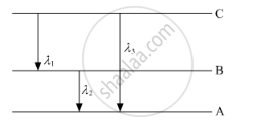
Explain, giving reasons, which of the following sets of quantum numbers are not possible.
- n = 0, l = 0, ml = 0, ms = + ½
- n = 1, l = 0, ml = 0, ms = – ½
- n = 1, l = 1, ml = 0, ms = + ½
- n = 2, l = 1, ml = 0, ms = – ½
- n = 3, l = 3, ml = –3, ms = + ½
- n = 3, l = 1, ml = 0, ms = + ½
Lifetimes of the molecules in the excited states are often measured by using pulsed radiation source of duration nearly in the nanosecond range. If the radiation source has a duration of 2 ns and the number of photons emitted during the pulse source is 2.5 × 10¹⁵, calculate the energy of the source.
If the velocity of the electron in Bohr’s first orbit is 2.19 × 10⁶ ms-1, calculate the de Broglie wavelength associated with it.
if `E_p` and `E_k` represent potential energy and kinetic energy respectively, of an orbital electron, then, according to B9hr's theory:
a)`E_k = -E_p"/"2`
b) `E_k = -E_p`
c) `E_k = -2E_p`
d) `E_k = 2E_p`
Using Bohr’s postulates, obtain the expression for total energy of the electron in the nth orbit of hydrogen atom.
Using Bohr’s postulates, derive the expression for the frequency of radiation emitted when electron in hydrogen atom undergoes transition from higher energy state (quantum number ni) to the lower state, (nf).
When electron in hydrogen atom jumps from energy state ni = 4 to nf = 3, 2, 1, identify the spectral series to which the emission lines belong.
Which of the following parameters are the same for all hydrogen-like atoms and ions in their ground states?
Evaluate Rydberg constant by putting the values of the fundamental constants in its expression.
According to Maxwell's theory of electrodynamics, an electron going in a circle should emit radiation of frequency equal to its frequency of revolution. What should be the wavelength of the radiation emitted by a hydrogen atom in ground state if this rule is followed?
Light from Balmer series of hydrogen is able to eject photoelectrons from a metal. What can be the maximum work function of the metal?
The earth revolves round the sun due to gravitational attraction. Suppose that the sun and the earth are point particles with their existing masses and that Bohr's quantization rule for angular momentum is valid in the case of gravitation. (a) Calculate the minimum radius the earth can have for its orbit. (b) What is the value of the principal quantum number n for the present radius? Mass of the earth = 6.0 × 10⁻²⁴ kg. Mass of the sun = 2.0 × 1030 kg, earth-sun distance = 1.5 × 10¹¹ m.
State any two Bohr’s postulates and write the energy value of the ground state of the hydrogen atom.
How are various lines of Lyman series formed? Explain on the basis of Bohr’s theory.
Use Bohr’s model of hydrogen atom to obtain the relationship between the angular momentum and the magnetic moment of the revolving electron.
The radius of the third Bohr orbit for hydrogen atom is ____________.
According to Bohr's model of hydrogen atom, an electron can revolve round a proton indefinitely, if its path is ______.
Using Bohr's postulates derive the expression for the radius of nth orbit of the electron.
Hydrogen atom has only one electron, so mutual repulsion between electrons is absent. However, in multielectron atoms mutual repulsion between the electrons is significant. How does this affect the energy of an electron in the orbitals of the same principal quantum number in multielectron atoms?
Derive an expression for the frequency of radiation emitted when a hydrogen atom de-excites from level n to level (n – 1). Also show that for large values of n, this frequency equals to classical frequency of revolution of an electron.
The angular momentum of electron in nth orbit is given by
Given below are two statements:
Statements I: According to Bohr's model of an atom, qualitatively the magnitude of velocity of electron increases with decrease in positive charges on the nucleus as there is no strong hold on the electron by the nucleus.
Statement II: According to Bohr's model of an atom, qualitatively the magnitude of velocity of electron increase with a decrease in principal quantum number.
In light of the above statements, choose the most appropriate answer from the options given below:
The number of times larger the spacing between the energy levels with n = 3 and n = 8 spacing between the energy level with n = 8 and n = 9 for the hydrogen atom is ______.
If 13.6 eV energy is required to ionize the hydrogen atom, then the energy required to remove an electron from n = 2 is ______.
A 100 eV electron collides with a stationary helium ion (He+) in its ground state and exits to a higher level. After the collision, He+ ions emit two photons in succession with wavelengths 1085 Å and 304 Å. The energy of the electron after the collision will be ______ eV.
Given h = 6.63 × 10⁻³⁴ Js.
According to Bohr's theory, the radius of the nth Bohr orbit of a hydrogen like atom of atomic number Z is proportional to ______.
The radius of the nth orbit in the Bohr model of hydrogen is proportional to ______.
The de Broglie wavelength of an electron in the first Bohr’s orbit of hydrogen atom is equal to ______.
What happens to an electron revolving in a circular orbit according to classical electromagnetic theory?
What happens when an electron makes the transition described by Bohr’s third postulate?
