Advertisements
Advertisements
प्रश्न
Calculate the radius of second Bohr orbit in hydrogen atom from the given data.
Mass of electron = 9.1 x 10⁻³¹kg
Charge on the electron = 1.6 x 10⁻¹⁹ C
Planck’s constant = 6.63 x 10⁻³⁴ J-s.
Permittivity of free space = 8.85 x 10⁻¹² C2/Nm2
Advertisements
उत्तर
`r_n=((h^2epsilon_0)/(pime^2))n^2`
`:.r_2=((h^2epsilon_0)/(pime^2))(2)^2`
`r_2=((6.63xx10^(-34))^2xx8.85xx10^(-12)xx(2)^2)/(3.14xx9.1xx10^(-31)xx(1.6xx10^(-19))^2)`
`=(43.96 xx 10^-68 xx 8.85 xx 10^-12 xx 4)/(3.14 xx 9.1 xx 10^-31 xx 2.56 xx 10^-38)`
=2.127x10⁻¹⁰m
=2.127 A°
APPEARS IN
संबंधित प्रश्न
(i) State Bohr's quantization condition for defining stationary orbits. How does the de Broglie hypothesis explain the stationary orbits?
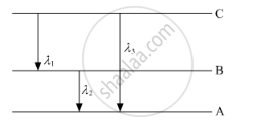
(ii) Find the relation between three wavelengths λ1, λ2 and λ3 from the energy-level diagram shown below.
State Bohr’s postulate of hydrogen atom which successfully explains the emission lines in the spectrum of hydrogen atom. Use Rydberg formula to determine the wavelength of Hα line. [Given: Rydberg constant R = 1.03 × 10⁷ m−1]
What is the energy in joules, required to shift the electron of the hydrogen atom from the first Bohr orbit to the fifth Bohr orbit and what is the wavelength of the light emitted when the electron returns to the ground state? The ground state electron energy is –2.18 × 10⁻¹¹ ergs.
Draw a neat, labelled energy level diagram for H atom showing the transitions. Explain the series of spectral lines for H atom, whose fixed inner orbit numbers are 3 and 4 respectively.
If the velocity of the electron in Bohr’s first orbit is 2.19 × 10⁶ ms-1, calculate the de Broglie wavelength associated with it.
The ratio of kinetic energy of an electron in Bohr’s orbit to its total energy in the same orbit is
(A) – 1
(B) 2
(C) 1/2
(D) – 0.5
In accordance with the Bohr’s model, find the quantum number that characterises the earth’s revolution around the sun in an orbit of radius 1.5 × 10¹¹ m with orbital speed 3 × 10⁴ m/s. (Mass of earth = 6.0 × 1024 kg)
The electron in hydrogen atom is initially in the third excited state. What is the maximum number of spectral lines which can be emitted when it finally moves to the ground state?
Write the expression for Bohr’s radius in hydrogen atom ?
A neutron moving with a speed υ strikes a hydrogen atom in ground state moving towards it with the same speed. Find the minimum speed of the neutron for which inelastic (completely or partially) collision may take place. The mass of neutron = mass of hydrogen = 1.67 × 10⁻²⁷ kg.v
Light from Balmer series of hydrogen is able to eject photoelectrons from a metal. What can be the maximum work function of the metal?
The earth revolves round the sun due to gravitational attraction. Suppose that the sun and the earth are point particles with their existing masses and that Bohr's quantization rule for angular momentum is valid in the case of gravitation. (a) Calculate the minimum radius the earth can have for its orbit. (b) What is the value of the principal quantum number n for the present radius? Mass of the earth = 6.0 × 10⁻²⁴ kg. Mass of the sun = 2.0 × 1030 kg, earth-sun distance = 1.5 × 10¹¹ m.
Write postulates of Bohr’s Theory of hydrogen atom.
Ratio of longest to shortest wavelength in Balmer series is ______.
The wavelength of the first time line of Ballmer series is 6563 A°. The Rydberg constant for hydrogen is about:-
For the ground state, the electron in the H-atom has an angular momentum = h, according to the simple Bohr model. Angular momentum is a vector and hence there will be infinitely many orbits with the vector pointing in all possible directions. In actuality, this is not true ______.
Consider aiming a beam of free electrons towards free protons. When they scatter, an electron and a proton cannot combine to produce a H-atom ______.
- because of energy conservation.
- without simultaneously releasing energy in the from of radiation.
- because of momentum conservation.
- because of angular momentum conservation.
The mass of a H-atom is less than the sum of the masses of a proton and electron. Why is this?
How will the energy of a hydrogen atom change if n increases from 1 to ∞?
State Bohr's postulate to explain stable orbits in a hydrogen atom. Prove that the speed with which the electron revolves in nth orbit is proportional to `(1/"n")`.
The number of times larger the spacing between the energy levels with n = 3 and n = 8 spacing between the energy level with n = 8 and n = 9 for the hydrogen atom is ______.
Orbits of a particle moving in a circle are such that the perimeter of the orbit equals an integer number of de-Broglie wavelengths of the particle. For a charged particle moving in a plane perpendicular to a magnetic field, the radius of the nth orbital will therefore be proportional to:
If 13.6 eV energy is required to ionize the hydrogen atom, then the energy required to remove an electron from n = 2 is ______.
In Bohr's theory of hydrogen atom, the electron jumps from higher orbit n to lower orbit p. The wavelength will be minimum for the transition ______.
Energy and radius of first Bohr orbit of He+ and Li2+ are:
[Given RH = −2.18 × 10⁻¹⁸ J, a0 = 52.9 pm]
Which from following is CORREСТ relationship between wavelength and momentum of electron?
Which principle did Bohr propose?
Which expression gives the quantised angular momentum of the orbiting electron?
What happens when an electron makes the transition described by Bohr’s third postulate?
