Advertisements
Advertisements
प्रश्न
For the ground state, the electron in the H-atom has an angular momentum = h, according to the simple Bohr model. Angular momentum is a vector and hence there will be infinitely many orbits with the vector pointing in all possible directions. In actuality, this is not true ______.
पर्याय
because Bohr model gives incorrect values of angular momentum.
because only one of these would have a minimum energy.
angular momentum must be in the direction of spin of electron.
because electrons go around only in horizontal orbits.
Advertisements
उत्तर
For the ground state, the electron in the H-atom has an angular momentum = h, according to the simple Bohr model. Angular momentum is a vector and hence there will be infinitely many orbits with the vector pointing in all possible directions. In actuality, this is not true because Bohr model gives incorrect values of angular momentum.
Explanation:
Bohr found that the magnitude of the electron’s angular momentum is quantized i.e. L = `mv_nr_n = n(h/(2pi))` where n = 1, 2 , 3, ...... each value of n corresponds to a permitted value of the orbit radius. rn = Radius of nth orbit, vn = corresponding speed
Bohr’s model gives only the magnitude of angular momentum. The angular momentum is a vector quantity. Hence we cannot express angular momentum completely by the Bohr model. Hence it does not give correct values of angular momentum of a revolving electron.
APPEARS IN
संबंधित प्रश्न
(i) State Bohr's quantization condition for defining stationary orbits. How does the de Broglie hypothesis explain the stationary orbits?
(ii) Find the relation between three wavelengths λ1, λ2 and λ3 from the energy-level diagram shown below.
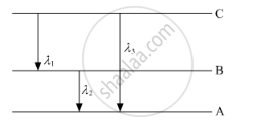
Using Bohr's postulates of the atomic model, derive the expression for radius of nth electron orbit. Hence obtain the expression for Bohr's radius.
Lifetimes of the molecules in the excited states are often measured by using pulsed radiation source of duration nearly in the nanosecond range. If the radiation source has a duration of 2 ns and the number of photons emitted during the pulse source is 2.5 × 10¹⁵, calculate the energy of the source.
If the velocity of the electron in Bohr’s first orbit is 2.19 × 10⁶ ms-1, calculate the de Broglie wavelength associated with it.
The ratio of kinetic energy of an electron in Bohr’s orbit to its total energy in the same orbit is
(A) – 1
(B) 2
(C) 1/2
(D) – 0.5
State Bohr postulate of hydrogen atom that gives the relationship for the frequency of emitted photon in a transition.
Using Bohr’s postulates, obtain the expressions for (i) kinetic energy and (ii) potential energy of the electron in stationary state of hydrogen atom.
Draw the energy level diagram showing how the transitions between energy levels result in the appearance of Lymann Series.
The electron in hydrogen atom is initially in the third excited state. What is the maximum number of spectral lines which can be emitted when it finally moves to the ground state?
When a photon is emitted by a hydrogen atom, the photon carries a momentum with it. (a) Calculate the momentum carries by the photon when a hydrogen atom emits light of wavelength 656.3 nm. (b) With what speed does the atom recoil during this transition? Take the mass of the hydrogen atom = 1.67 × 10⁻²⁷ kg. (c) Find the kinetic energy of recoil of the atom.
Light from Balmer series of hydrogen is able to eject photoelectrons from a metal. What can be the maximum work function of the metal?
Suppose in an imaginary world the angular momentum is quantized to be even integral multiples of h/2π. What is the longest possible wavelength emitted by hydrogen atoms in visible range in such a world according to Bohr's model?
In which of the following systems will the wavelength corresponding to n = 2 to n = 1 be minimum?
According to the Bohr theory of H-atom, the speed of the electron, its energy and the radius of its orbit varies with the principal quantum number n, respectively, as:
The number of times larger the spacing between the energy levels with n = 3 and n = 8 spacing between the energy level with n = 8 and n = 9 for the hydrogen atom is ______.
An electron in H-atom makes a transition from n = 3 to n = 1. The recoil momentum of the H-atom will be ______.
Oxygen is 16 times heavier than hydrogen. Equal volumes of hydrogen and oxygen are mixed. The ratio of speed of sound in the mixture to that in hydrogen is ______.
State three postulates of Bohr's theory of hydrogen atom.
Energy and radius of first Bohr orbit of He+ and Li2+ are:
[Given RH = −2.18 × 10⁻¹⁸ J, a0 = 52.9 pm]
If a revolving electron emitted radiation continuously, what would equal the frequency of emitted radiation?
Which expression gives the orbital frequency used to calculate the initial frequency of light emitted under classical electromagnetic theory?
