Advertisements
Advertisements
प्रश्न
Draw a neat, labelled energy level diagram for H atom showing the transitions. Explain the series of spectral lines for H atom, whose fixed inner orbit numbers are 3 and 4 respectively.
Advertisements
उत्तर
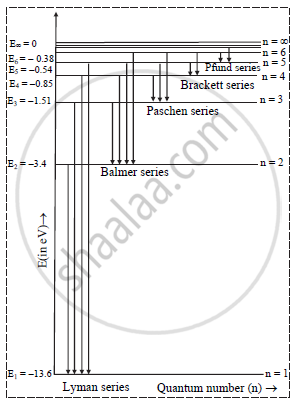
Paschen series:
i. The spectral lines of this series correspond to the transition of an electron from some higher energy state to 3rd orbit.
ii. For paschen series, p = 3 and n = 4, 5,...
The wave numbers and the wavelengths of the spectral lines constituting the Paschen series are given by,
`barv=1/lambda=R(1/3^2-1/n^2)`
iii. Paschen series lies in the infrared region of the spectrum which is invisible and contains infinite number of lines.
iv. Wavelengths for n = 4 and 5 are 18750 Å and 12820 Å respectively.
Brackett series:
i. The spectral lines of this series corresponds to the transition of an electron from a higher energy state to the 4th orbit.
ii. For this series, p = 4 and n = 5, 6, 7,...
The wave numbers and the wavelengths of the spectral lines constituting the Brackett series are given by,
`barv=1/lambda=R(1/4^2-1/n^2)`
iii. This series lies in the ne ar infrared region of the spectrum and contains infinite number of lines. Wavelengths for n = 5 and 6, are 40518 Å and 26253 Å respectively
APPEARS IN
संबंधित प्रश्न
State Bohr’s postulate of hydrogen atom which successfully explains the emission lines in the spectrum of hydrogen atom. Use Rydberg formula to determine the wavelength of Hα line. [Given: Rydberg constant R = 1.03 × 10⁷ m−1]
The longest wavelength doublet absorption transition is observed at 589 and 589.6 nm. Calculate the frequency of each transition and energy difference between two excited states.
If the velocity of the electron in Bohr’s first orbit is 2.19 × 10⁶ ms-1, calculate the de Broglie wavelength associated with it.
In accordance with the Bohr’s model, find the quantum number that characterises the earth’s revolution around the sun in an orbit of radius 1.5 × 10¹¹ m with orbital speed 3 × 10⁴ m/s. (Mass of earth = 6.0 × 1024 kg)
State Bohr's postulate to define stable orbits in the hydrogen atom. How does de Broglie's hypothesis explain the stability of these orbits?
Using Bohr’s postulates, derive the expression for the frequency of radiation emitted when electron in hydrogen atom undergoes transition from higher energy state (quantum number ni) to the lower state, (nf).
When electron in hydrogen atom jumps from energy state ni = 4 to nf = 3, 2, 1, identify the spectral series to which the emission lines belong.
A positive ion having just one electron ejects it if a photon of wavelength 228 Å or less is absorbed by it. Identify the ion.
A beam of monochromatic light of wavelength λ ejects photoelectrons from a cesium surface (Φ = 1.9 eV). These photoelectrons are made to collide with hydrogen atoms in ground state. Find the maximum value of λ for which (a) hydrogen atoms may be ionized, (b) hydrogen atoms may get excited from the ground state to the first excited state and (c) the excited hydrogen atoms may emit visible light.
The light emitted in the transition n = 3 to n = 2 in hydrogen is called Hα light. Find the maximum work function a metal can have so that Hα light can emit photoelectrons from it.
The earth revolves round the sun due to gravitational attraction. Suppose that the sun and the earth are point particles with their existing masses and that Bohr's quantization rule for angular momentum is valid in the case of gravitation. (a) Calculate the minimum radius the earth can have for its orbit. (b) What is the value of the principal quantum number n for the present radius? Mass of the earth = 6.0 × 10⁻²⁴ kg. Mass of the sun = 2.0 × 1030 kg, earth-sun distance = 1.5 × 10¹¹ m.
Obtain Bohr’s quantisation condition for angular momentum of electron orbiting in nth orbit in hydrogen atom on the basis of the wave picture of an electron using de Broglie hypothesis.
How are various lines of Lyman series formed? Explain on the basis of Bohr’s theory.
Answer the following question.
Calculate the orbital period of the electron in the first excited state of the hydrogen atom.
In Bohr model of hydrogen atom, which of the following is quantised?
Calculate the energy and frequency of the radiation emitted when an electron jumps from n = 3 to n = 2 in a hydrogen atom.
Consider two different hydrogen atoms. The electron in each atom is in an excited state. Is it possible for the electrons to have different energies but same orbital angular momentum according to the Bohr model? Justify your answer.
According to the Bohr theory of H-atom, the speed of the electron, its energy and the radius of its orbit varies with the principal quantum number n, respectively, as:
How will the energy of a hydrogen atom change if n increases from 1 to ∞?
An electron in H-atom makes a transition from n = 3 to n = 1. The recoil momentum of the H-atom will be ______.
In Bohr's atomic model of hydrogen, let K. P and E are the kinetic energy, potential energy and total energy of the electron respectively. Choose the correct option when the electron undergoes transitions to a higher level:
The energy required to remove the electron from a singly ionized Helium atom is 2.2 times the energy required to remove an electron from Helium atom. The total energy required to ionize the Helium atom completely is ______.
On the basis of Bohr's theory, derive an expression for the radius of the nth orbit of an electron of hydrogen atom.
State the Bohr's postulate of angular momentum of an electron.
For the reaction \[\ce{2NO2 (g) ⇌ N2O4(g)}\], when ΔS = −176.0 JK−1 and ΔH = −57.8 kj mol−1, the magnitude of ΔG at 298 K for the reaction is ______ kJ mol−1. (Nearest integer)
What happens to an electron revolving in a circular orbit according to classical electromagnetic theory?
For an orbit radius of \[5.3\times10^{-11}\,\mathrm{m}\] and an electron velocity of \[2.2\times10^6\,\mathrm{m\,s^{-1}}\], what is the approximate initial frequency of emitted light according to classical electromagnetic theory?
