Advertisements
Advertisements
Question
Draw a neat, labelled energy level diagram for H atom showing the transitions. Explain the series of spectral lines for H atom, whose fixed inner orbit numbers are 3 and 4 respectively.
Advertisements
Solution
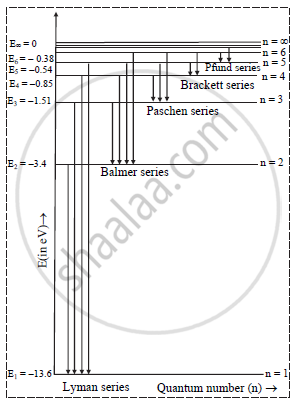
Paschen series:
i. The spectral lines of this series correspond to the transition of an electron from some higher energy state to 3rd orbit.
ii. For paschen series, p = 3 and n = 4, 5,...
The wave numbers and the wavelengths of the spectral lines constituting the Paschen series are given by,
`barv=1/lambda=R(1/3^2-1/n^2)`
iii. Paschen series lies in the infrared region of the spectrum which is invisible and contains infinite number of lines.
iv. Wavelengths for n = 4 and 5 are 18750 Å and 12820 Å respectively.
Brackett series:
i. The spectral lines of this series corresponds to the transition of an electron from a higher energy state to the 4th orbit.
ii. For this series, p = 4 and n = 5, 6, 7,...
The wave numbers and the wavelengths of the spectral lines constituting the Brackett series are given by,
`barv=1/lambda=R(1/4^2-1/n^2)`
iii. This series lies in the ne ar infrared region of the spectrum and contains infinite number of lines. Wavelengths for n = 5 and 6, are 40518 Å and 26253 Å respectively
APPEARS IN
RELATED QUESTIONS
Obtain an expression for the radius of Bohr orbit for H-atom.
State Bohr’s postulate of hydrogen atom which successfully explains the emission lines in the spectrum of hydrogen atom. Use Rydberg formula to determine the wavelength of Hα line. [Given: Rydberg constant R = 1.03 × 10⁷ m−1]
The energy associated with the first orbit in the hydrogen atom is - 2.18 × 10⁻¹⁸ J atom-1. What is the energy associated with the fifth orbit?
How many electrons in an atom may have the following quantum numbers?
n = 3, l = 0
Show that the circumference of the Bohr orbit for the hydrogen atom is an integral multiple of the de Broglie wavelength associated with the electron revolving around the orbit.
If the photon of the wavelength 150 pm strikes an atom and one of its inner bound electrons is ejected out with a velocity of 1.5 × 10⁷ ms–1, calculate the energy with which it is bound to the nucleus.
On the basis of Bohr's theory, derive an expression for the radius of the nth orbit of an electron of the hydrogen atom.
State Bohr postulate of hydrogen atom that gives the relationship for the frequency of emitted photon in a transition.
The electron in hydrogen atom is initially in the third excited state. What is the maximum number of spectral lines which can be emitted when it finally moves to the ground state?
Evaluate Rydberg constant by putting the values of the fundamental constants in its expression.
A parallel beam of light of wavelength 100 nm passes through a sample of atomic hydrogen gas in ground state. (a) Assume that when a photon supplies some of its energy to a hydrogen atom, the rest of the energy appears as another photon. Neglecting the light emitted by the excited hydrogen atoms in the direction of the incident beam, what wavelengths may be observed in the transmitted beam? (b) A radiation detector is placed near the gas to detect radiation coming perpendicular to the incident beam. Find the wavelengths of radiation that may be detected by the detector.
When a photon is emitted by a hydrogen atom, the photon carries a momentum with it. (a) Calculate the momentum carries by the photon when a hydrogen atom emits light of wavelength 656.3 nm. (b) With what speed does the atom recoil during this transition? Take the mass of the hydrogen atom = 1.67 × 10⁻²⁷ kg. (c) Find the kinetic energy of recoil of the atom.
The light emitted in the transition n = 3 to n = 2 in hydrogen is called Hα light. Find the maximum work function a metal can have so that Hα light can emit photoelectrons from it.
If l3 and l2 represent angular momenta of an orbiting electron in III and II Bohr orbits respectively, then l3: l2 is :
Write postulates of Bohr’s Theory of hydrogen atom.
According to Bohr's model of hydrogen atom, an electron can revolve round a proton indefinitely, if its path is ______.
Hydrogen atom has only one electron, so mutual repulsion between electrons is absent. However, in multielectron atoms mutual repulsion between the electrons is significant. How does this affect the energy of an electron in the orbitals of the same principal quantum number in multielectron atoms?
A set of atoms in an excited state decays ______.
Using Bohr model, calculate the electric current created by the electron when the H-atom is in the ground state.
The radius of the innermost electron orbit of a hydrogen atom is 5.3 × 10⁻¹¹m. The radius of the n = 3 orbit is ______.
Use Bohr's postulate to prove that the radius of nth orbit in a hydrogen atom is proportional to n2.
The value of angular momentum for He+ ion in the first Bohr orbit is ______.
According to Bohr atom model, in which of the following transitions will the frequency be maximum?
The electron in a hydrogen atom first jumps from the third excited state to the second excited state and subsequently to the first excited state. The ratio of the respective wavelengths, λ1/λ2, of the photons emitted in this process is ______.
An electron in a hydrogen atom has an energy of -3.4 eV. The difference between its kinetic and potential energy is ______.
Specify the transition of an electron in the wavelength of the line in the Bohr model of the hydrogen atom which gives rise to the spectral line of the highest wavelength ______.
Which law of force governs the nucleus-electron system?
Which expression gives the quantised angular momentum of the orbiting electron?
What happens when an electron makes the transition described by Bohr’s third postulate?
