Advertisements
Advertisements
Question
The longest wavelength doublet absorption transition is observed at 589 and 589.6 nm. Calculate the frequency of each transition and energy difference between two excited states.
Advertisements
Solution
For λ1 = 589 nm
Frequency of transition `("v"_1) = "c"/lambda_1`
`= (3.0xx10^(8) " ms"^(-1))/(589xx10^(-9) " m")`
Frequency of transition (ν1) = 5.093 × 10¹⁴ s–1
Similarly, for λ2 = 589.6 nm
Frequency of transition `("v"_2) = "c"/lambda_2`
`= (3.0 xx 10^8 " ms"^(-1))/(589.6xx10^(-9) " m")`
Frequency of transition (ν2) = 5.088 × 10¹⁴ s–1
Energy difference (ΔE) between excited states = E1 – E2
Where,
E2 = energy associated with λ2
E1 = energy associated with λ1
ΔE = hν1 – hν2
= h(ν1 – ν2)
= (6.626 × 10⁻³⁴ Js) (5.093 × 10¹⁴ – 5.088 × 10¹⁴)s-1
= (6.626 × 10⁻³⁴ J) (5.0 × 10-3 × 1014)
ΔE = 3.31 × 10⁻²² J
APPEARS IN
RELATED QUESTIONS
(i) State Bohr's quantization condition for defining stationary orbits. How does the de Broglie hypothesis explain the stationary orbits?
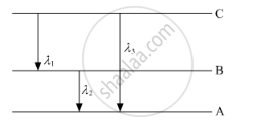
(ii) Find the relation between three wavelengths λ1, λ2 and λ3 from the energy-level diagram shown below.
What is the energy in joules, required to shift the electron of the hydrogen atom from the first Bohr orbit to the fifth Bohr orbit and what is the wavelength of the light emitted when the electron returns to the ground state? The ground state electron energy is –2.18 × 10⁻¹¹ ergs.
The numerical value of ionization energy in eV equals the ionization potential in volts. Does the equality hold if these quantities are measured in some other units?
A filter transmits only the radiation of wavelength greater than 440 nm. Radiation from a hydrogen-discharge tube goes through such a filter and is incident on a metal of work function 2.0 eV. Find the stopping potential which can stop the photoelectrons.
Consider a neutron and an electron bound to each other due to gravitational force. Assuming Bohr's quantization rule for angular momentum to be valid in this case, derive an expression for the energy of the neutron-electron system.
According to Bohr, 'Angular momentum of an orbiting electron is quantized'. What is meant by this statement?
Mention demerits of Bohr’s Atomic model.
The binding energy of a H-atom, considering an electron moving around a fixed nuclei (proton), is B = `- (Me^4)/(8n^2ε_0^2h^2)`. (m = electron mass). If one decides to work in a frame of reference where the electron is at rest, the proton would be moving around it. By similar arguments, the binding energy would be
B = `- (Me^4)/(8n^2ε_0^2h^2)` (M = proton mass)
This last expression is not correct because ______.
Taking the Bohr radius as a0 = 53 pm, the radius of Li++ ion in its ground state, on the basis of Bohr’s model, will be about ______.
When an electron falls from a higher energy to a lower energy level, the difference in the energies appears in the form of electromagnetic radiation. Why cannot it be emitted as other forms of energy?
The inverse square law in electrostatics is |F| = `e^2/((4πε_0).r^2)` for the force between an electron and a proton. The `(1/r)` dependence of |F| can be understood in quantum theory as being due to the fact that the ‘particle’ of light (photon) is massless. If photons had a mass mp, force would be modified to |F| = `e^2/((4πε_0)r^2) [1/r^2 + λ/r]`, exp (– λr) where λ = mpc/h and h = `h/(2π)`. Estimate the change in the ground state energy of a H-atom if mp were 10-6 times the mass of an electron.
The value of angular momentum for He+ ion in the first Bohr orbit is ______.
A hydrogen atom in is ground state absorbs 10.2 eV of energy. The angular momentum of electron of the hydrogen atom will increase by the value of ______.
(Given, Planck's constant = 6.6 × 10⁻³⁴ Js)
According to Bohr's theory, the radius of the nth Bohr orbit of a hydrogen like atom of atomic number Z is proportional to ______.
Hydrogen atom from excited state comes to the ground state by emitting a photon of wavelength λ. If R is the Rydberg constant then the principal quantum number n of the excited state is ______.
How much is the angular momentum of an electron when it is orbiting in the second Bohr orbit of hydrogen atom?
Calculate the radius of the second orbit of He+.
The radius of hydrogen atom in the ground state is 0.53 Å. The radius of Li2+ ion (atomic number = 3) in a similar state is ______.
What does Bohr’s first postulate allow an electron in an atom to do?
What happens when an electron makes the transition described by Bohr’s third postulate?
