Advertisements
Advertisements
प्रश्न
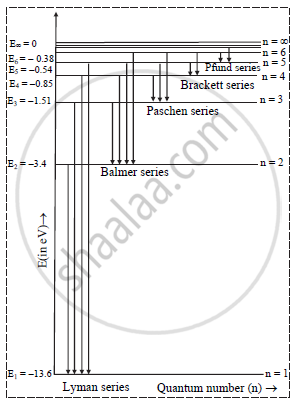
Draw a neat, labelled energy level diagram for H atom showing the transitions. Explain the series of spectral lines for H atom, whose fixed inner orbit numbers are 3 and 4 respectively.
Advertisements
उत्तर
Paschen series:
i. The spectral lines of this series correspond to the transition of an electron from some higher energy state to 3rd orbit.
ii. For paschen series, p = 3 and n = 4, 5,...
The wave numbers and the wavelengths of the spectral lines constituting the Paschen series are given by,
`barv=1/lambda=R(1/3^2-1/n^2)`
iii. Paschen series lies in the infrared region of the spectrum which is invisible and contains infinite number of lines.
iv. Wavelengths for n = 4 and 5 are 18750 Å and 12820 Å respectively.
Brackett series:
i. The spectral lines of this series corresponds to the transition of an electron from a higher energy state to the 4th orbit.
ii. For this series, p = 4 and n = 5, 6, 7,...
The wave numbers and the wavelengths of the spectral lines constituting the Brackett series are given by,
`barv=1/lambda=R(1/4^2-1/n^2)`
iii. This series lies in the ne ar infrared region of the spectrum and contains infinite number of lines. Wavelengths for n = 5 and 6, are 40518 Å and 26253 Å respectively
APPEARS IN
संबंधित प्रश्न
(i) State Bohr's quantization condition for defining stationary orbits. How does the de Broglie hypothesis explain the stationary orbits?
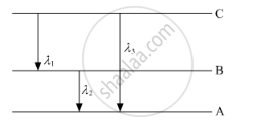
(ii) Find the relation between three wavelengths λ1, λ2 and λ3 from the energy-level diagram shown below.
Calculate the radius of second Bohr orbit in hydrogen atom from the given data.
Mass of electron = 9.1 x 10⁻³¹kg
Charge on the electron = 1.6 x 10⁻¹⁹ C
Planck’s constant = 6.63 x 10⁻³⁴ J-s.
Permittivity of free space = 8.85 x 10⁻¹² C2/Nm2
State Bohr’s postulate of hydrogen atom which successfully explains the emission lines in the spectrum of hydrogen atom. Use Rydberg formula to determine the wavelength of Hα line. [Given: Rydberg constant R = 1.03 × 10⁷ m−1]
The longest wavelength doublet absorption transition is observed at 589 and 589.6 nm. Calculate the frequency of each transition and energy difference between two excited states.
State Bohr's postulate to define stable orbits in the hydrogen atom. How does de Broglie's hypothesis explain the stability of these orbits?
On the basis of Bohr's theory, derive an expression for the radius of the nth orbit of an electron of the hydrogen atom.
Write the expression for Bohr’s radius in hydrogen atom ?
Find the wavelength of the radiation emitted by hydrogen in the transitions (a) n = 3 to n= 2, (b) n = 5 to n = 4 and (c) n = 10 to n = 9.
According to Maxwell's theory of electrodynamics, an electron going in a circle should emit radiation of frequency equal to its frequency of revolution. What should be the wavelength of the radiation emitted by a hydrogen atom in ground state if this rule is followed?
Light from Balmer series of hydrogen is able to eject photoelectrons from a metal. What can be the maximum work function of the metal?
Answer the following question.
Calculate the orbital period of the electron in the first excited state of the hydrogen atom.
When the electron orbiting in hydrogen atom in its ground state moves to the third excited state, show how the de Broglie wavelength associated with it would be affected.
What is the energy in joules released when an electron moves from n = 2 to n = 1 level in a hydrogen atom?
A particle has a mass of 0.002 kg and uncertainty in its velocity is 9.2 × 10⁻⁶ m/s, then uncertainty in position is ≥ ____________.
(h = 6.6 × 10⁻³⁴ J s)
Why was a change in the Bohr Model of atom required? Due to which important development (s), concept of movement of an electron in an orbit was replaced by, the concept of probability of finding electron in an orbital? What is the name given to the changed model of atom?
Derive an expression for the frequency of radiation emitted when a hydrogen atom de-excites from level n to level (n – 1). Also show that for large values of n, this frequency equals to classical frequency of revolution of an electron.
In form of Rydberg's constant R, the wave no of this first Ballmer line is
An ionised H-molecule consists of an electron and two protons. The protons are separated by a small distance of the order of angstrom. In the ground state ______.
- the electron would not move in circular orbits.
- the energy would be (2)4 times that of a H-atom.
- the electrons, orbit would go around the protons.
- the molecule will soon decay in a proton and a H-atom.
The mass of a H-atom is less than the sum of the masses of a proton and electron. Why is this?
Using Bohr model, calculate the electric current created by the electron when the H-atom is in the ground state.
State Bohr's postulate to explain stable orbits in a hydrogen atom. Prove that the speed with which the electron revolves in nth orbit is proportional to `(1/"n")`.
The wavelength in Å of the photon that is emitted when an electron in Bohr orbit with n = 2 returns to orbit with n = 1 in H atom is ______ Å. The ionisation potential of the ground state of the H-atom is 2.17 × 10⁻¹¹ erg.
If 13.6 eV energy is required to ionize the hydrogen atom, then the energy required to remove an electron from n = 2 is ______.
Specify the transition of an electron in the wavelength of the line in the Bohr model of the hydrogen atom which gives rise to the spectral line of the highest wavelength ______.
Find the angular momentum of an electron revolving in the second orbit in Bohr's hydrogen atom.
The de Broglie wavelength of an electron in the first Bohr’s orbit of hydrogen atom is equal to ______.
Calculate the radius of the second orbit of He+.
Calculate the shortest wavenumber in hydrogen spectrum of Lyman series. (RH = 109677 cm−1)
What does classical electromagnetic theory predict for an accelerating charged particle?
