Advertisements
Advertisements
प्रश्न
Write postulates of Bohr’s Theory of hydrogen atom.
Advertisements
उत्तर
Postulates of Bohr’s theory of hydrogen atom:
- The electron in the hydrogen atom can move around the nucleus in one of the many possible circular paths of fixed radius and energy. These paths are called orbits, stationary states, or allowed energy states. These orbits are arranged concentrically around the nucleus in increasing order of energy.
- The energy of an electron in the orbit does not change with time. However, the electron will move from a lower stationary state to a higher stationary state if and when the required amount of energy is absorbed by the electron. Energy is emitted when an electron moves from a higher stationary state to a lower stationary state. The energy change does not take place in a continuous manner.
- The frequency of radiation absorbed or emitted when transition occurs between two stationary states that differ in energy by ΔE is given by the following expression:
v = `(Δ"E")/"h"=("E"_2-"E"_1)/"h"` ......(1)
Where E1 and E2 are the energies of the lower and higher allowed energy states respectively. This expression is commonly known as Bohr’s frequency rule. - The angular momentum of an electron in a given stationary state can be expressed as mvr = `"n" × "h"/(2π)`
where, n = 1, 2, 3
Thus, an electron can move only in those orbits for which its angular momentum is an integral multiple of h/2π. Thus, only certain fixed orbits are allowed.
APPEARS IN
संबंधित प्रश्न
An electron is orbiting in 5th Bohr orbit. Calculate ionisation energy for this atom, if the ground state energy is -13.6 eV.
(i) State Bohr's quantization condition for defining stationary orbits. How does the de Broglie hypothesis explain the stationary orbits?
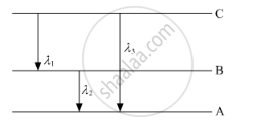
(ii) Find the relation between three wavelengths λ1, λ2 and λ3 from the energy-level diagram shown below.
Calculate the radius of second Bohr orbit in hydrogen atom from the given data.
Mass of electron = 9.1 x 10⁻³¹kg
Charge on the electron = 1.6 x 10⁻¹⁹ C
Planck’s constant = 6.63 x 10⁻³⁴ J-s.
Permittivity of free space = 8.85 x 10⁻¹² C2/Nm2
If the photon of the wavelength 150 pm strikes an atom and one of its inner bound electrons is ejected out with a velocity of 1.5 × 10⁷ ms–1, calculate the energy with which it is bound to the nucleus.
If the velocity of the electron in Bohr’s first orbit is 2.19 × 10⁶ ms-1, calculate the de Broglie wavelength associated with it.
In accordance with the Bohr’s model, find the quantum number that characterises the earth’s revolution around the sun in an orbit of radius 1.5 × 10¹¹ m with orbital speed 3 × 10⁴ m/s. (Mass of earth = 6.0 × 1024 kg)
The gravitational attraction between electron and proton in a hydrogen atom is weaker than the Coulomb attraction by a factor of about 10−40. An alternative way of looking at this fact is to estimate the radius of the first Bohr orbit of a hydrogen atom if the electron and proton were bound by gravitational attraction. You will find the answer interesting.
When a photon stimulates the emission of another photon, the two photons have
(a) same energy
(b) same direction
(c) same phase
(d) same wavelength
Find the wavelength of the radiation emitted by hydrogen in the transitions (a) n = 3 to n= 2, (b) n = 5 to n = 4 and (c) n = 10 to n = 9.
A beam of light having wavelengths distributed uniformly between 450 nm to 550 nm passes through a sample of hydrogen gas. Which wavelength will have the least intensity in the transmitted beam?
When the electron orbiting in hydrogen atom in its ground state moves to the third excited state, show how the de Broglie wavelength associated with it would be affected.
According to Bohr's theory, an electron can move only in those orbits for which its angular momentum is integral multiple of ____________.
For an electron in the second orbit of hydrogen, what is the moment of momentum as per the Bohr's model?
If the radius of first electron orbit in hydrogen atom be r then the radius of the fourth orbit ill be ______.
Calculate the energy and frequency of the radiation emitted when an electron jumps from n = 3 to n = 2 in a hydrogen atom.
The ratio of the ionization energy of H and Be+3 is ______.
Using Bohr model, calculate the electric current created by the electron when the H-atom is in the ground state.
Use Bohr's postulate to prove that the radius of nth orbit in a hydrogen atom is proportional to n2.
The value of angular momentum for He+ ion in the first Bohr orbit is ______.
The number of times larger the spacing between the energy levels with n = 3 and n = 8 spacing between the energy level with n = 8 and n = 9 for the hydrogen atom is ______.
The line at 434 nm in the Balmer series of the hydrogen spectrum corresponds to a transition of an electron from the nth to second Bohr orbit. The value of n is ______.
The wavelength of the second line of the Balmer series in the hydrogen spectrum is 4861 Å. Calculate the wavelength of the first line of the same series.
For the reaction \[\ce{2NO2 (g) ⇌ N2O4(g)}\], when ΔS = −176.0 JK−1 and ΔH = −57.8 kj mol−1, the magnitude of ΔG at 298 K for the reaction is ______ kJ mol−1. (Nearest integer)
What would happen to a revolving electron that continuously lost energy?
What spectrum would an atom emit if its electron spiralled inward while emitting radiation continuously?
What does Bohr’s first postulate allow an electron in an atom to do?
Which expression gives the quantised angular momentum of the orbiting electron?
What happens when an electron makes the transition described by Bohr’s third postulate?
Which expression gives the orbital frequency used to calculate the initial frequency of light emitted under classical electromagnetic theory?
