Advertisements
Advertisements
प्रश्न
In accordance with the Bohr’s model, find the quantum number that characterises the earth’s revolution around the sun in an orbit of radius 1.5 × 10¹¹ m with orbital speed 3 × 10⁴ m/s. (Mass of earth = 6.0 × 1024 kg)
Advertisements
उत्तर
Radius of the orbit of the earth around the sun, r = 1.5 × 10¹¹ m
Orbital speed of the earth, v = 3 × 10⁴ m/s
Mass of the earth, m = 6.0 × 1024 kg
According to Bohr’s model, angular momentum is quantised and given as:
mvr = `(nh)/(2pi)`
Where,
h = Planck’s constant = 6.62 × 10⁻³⁴ Js
n = Quantum number
∴ n = `(mvr 2pi)/h`
= `(2pi xx 6 xx 10^24xx 3 xx 10^4 xx1.5 xx 10^(11))/(6.62 xx 10^(-34))`
= 25.61 × 1073
= 2.6 × 1074
Hence, the quantum number that characterises the earth’s revolution is 2.6 × 1074.
संबंधित प्रश्न
(i) State Bohr's quantization condition for defining stationary orbits. How does the de Broglie hypothesis explain the stationary orbits?
(ii) Find the relation between three wavelengths λ1, λ2 and λ3 from the energy-level diagram shown below.
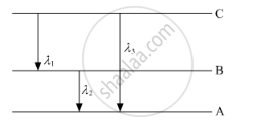
Using Bohr's postulates of the atomic model, derive the expression for radius of nth electron orbit. Hence obtain the expression for Bohr's radius.
- Using the Bohr’s model, calculate the speed of the electron in a hydrogen atom in the n = 1, 2 and 3 levels.
- Calculate the orbital period in each of these levels.
State Bohr postulate of hydrogen atom that gives the relationship for the frequency of emitted photon in a transition.
Using Bohr’s postulates, obtain the expression for total energy of the electron in the nth orbit of hydrogen atom.
The Bohr radius is given by `a_0 = (∈_0h^2)/{pime^2}`. Verify that the RHS has dimensions of length.
According to Maxwell's theory of electrodynamics, an electron going in a circle should emit radiation of frequency equal to its frequency of revolution. What should be the wavelength of the radiation emitted by a hydrogen atom in ground state if this rule is followed?
According to Bohr's theory, an electron can move only in those orbits for which its angular momentum is integral multiple of ____________.
The spectral line obtained when an electron jumps from n = 5 to n = 2 level in hydrogen atom belongs to the ____________ series.
According to Bhor' s theory the moment of momentum of an electron revolving in second orbit of hydrogen atom will be.
Taking the Bohr radius as a0 = 53 pm, the radius of Li++ ion in its ground state, on the basis of Bohr’s model, will be about ______.
The inverse square law in electrostatics is |F| = `e^2/((4πε_0).r^2)` for the force between an electron and a proton. The `(1/r)` dependence of |F| can be understood in quantum theory as being due to the fact that the ‘particle’ of light (photon) is massless. If photons had a mass mp, force would be modified to |F| = `e^2/((4πε_0)r^2) [1/r^2 + λ/r]`, exp (– λr) where λ = mpc/h and h = `h/(2π)`. Estimate the change in the ground state energy of a H-atom if mp were 10-6 times the mass of an electron.
The value of angular momentum for He+ ion in the first Bohr orbit is ______.
In hydrogen atom, transition from the state n = 6 to n = 1 results in ultraviolet radiation. Infrared radiation will be obtained in the transition ______.
Specify the transition of an electron in the wavelength of the line in the Bohr model of the hydrogen atom which gives rise to the spectral line of the highest wavelength ______.
How much is the angular momentum of an electron when it is orbiting in the second Bohr orbit of hydrogen atom?
Calculate the shortest wavenumber in hydrogen spectrum of Lyman series. (RH = 109677 cm−1)
Which law of force governs the nucleus-electron system?
Which expression gives the orbital frequency used to calculate the initial frequency of light emitted under classical electromagnetic theory?
