Advertisements
Advertisements
प्रश्न
(i) State Bohr's quantization condition for defining stationary orbits. How does the de Broglie hypothesis explain the stationary orbits?
(ii) Find the relation between three wavelengths λ1, λ2 and λ3 from the energy-level diagram shown below.
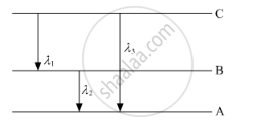
Advertisements
उत्तर
(a) Bohr's quantisation condition: According to Bohr, an electron can revolve only in certain discrete, non-radiating orbits for which total angular momentum of the revolving electron is an integral multiple of `h/(2pi)`where h is the Planck's constant.
`:.mvr=(nh)/(2pi)`
(b) Using the Rydberg formula of the spectra of hydrogen atom, we write
`1/lamda_1=R(1/n_(2^2)-1/n_(3^2)) ......(1)`
`1/lamda_2=R(1/n_(1^2)-1/n_(2^2)) ......(2)`
`1/lamda_3=R(1/n_(1^2)-1/n_(3^2)) ......(3)`
Adding (1) and (2), we find that
`1/lambda_1+1/(lambda_2)=R(1/n_(1^2)-1/n_(3^2))=1/lambda_3`
This is the required relation between the three wavelengths.
संबंधित प्रश्न
An electron is orbiting in 5th Bohr orbit. Calculate ionisation energy for this atom, if the ground state energy is -13.6 eV.
What is the maximum number of emission lines when the excited electron of an H atom in n = 6 drops to the ground state?
If the velocity of the electron in Bohr’s first orbit is 2.19 × 10⁶ ms-1, calculate the de Broglie wavelength associated with it.
The difference in the frequencies of series limit of Lyman series and Balmer series is equal to the frequency of the first line of the Lyman series. Explain.
The light emitted in the transition n = 3 to n = 2 in hydrogen is called Hα light. Find the maximum work function a metal can have so that Hα light can emit photoelectrons from it.
Consider two different hydrogen atoms. The electron in each atom is in an excited state. Is it possible for the electrons to have different energies but same orbital angular momentum according to the Bohr model? Justify your answer.
An ionised H-molecule consists of an electron and two protons. The protons are separated by a small distance of the order of angstrom. In the ground state ______.
- the electron would not move in circular orbits.
- the energy would be (2)4 times that of a H-atom.
- the electrons, orbit would go around the protons.
- the molecule will soon decay in a proton and a H-atom.
The inverse square law in electrostatics is |F| = `e^2/((4πε_0).r^2)` for the force between an electron and a proton. The `(1/r)` dependence of |F| can be understood in quantum theory as being due to the fact that the ‘particle’ of light (photon) is massless. If photons had a mass mp, force would be modified to |F| = `e^2/((4πε_0)r^2) [1/r^2 + λ/r]`, exp (– λr) where λ = mpc/h and h = `h/(2π)`. Estimate the change in the ground state energy of a H-atom if mp were 10-6 times the mass of an electron.
A 100 eV electron collides with a stationary helium ion (He+) in its ground state and exits to a higher level. After the collision, He+ ions emit two photons in succession with wavelengths 1085 Å and 304 Å. The energy of the electron after the collision will be ______ eV.
Given h = 6.63 × 10⁻³⁴ Js.
Find the angular momentum of an electron revolving in the second orbit in Bohr's hydrogen atom.
